Cross Stitch vs Embroidery vs Needlepoint
Cross stitch is a kind of embroidery, so the real comparison is counted cross stitch against freehand surface embroidery. Cross stitch works on a counted grid, one stitch per square, always the same stitch. Embroidery is drawn freehand, with many stitches. Needlepoint is counted too, but covers the whole canvas in one diagonal.
The one distinction that explains all the others
Cross stitch is counted. The cloth carries a grid, the chart carries a grid, and your job is to match them. Nothing is drawn on the fabric and nothing is judged by eye.
Surface embroidery is not counted. A design is traced onto plain cloth and you fill it with whatever stitches suit it, judging length and angle by hand.
Needlepoint is counted, like cross stitch, but it covers the canvas completely with a single diagonal per hole, and it is usually worked in wool on a stiff open mesh.
Everything below follows from those three sentences.
Side by side
| Cross stitch | Surface embroidery | Needlepoint | |
|---|---|---|---|
| Grid | yes, in the cloth | none | yes, in the canvas |
| Stitches used | one | dozens | one, mostly tent |
| Cloth | aida, evenweave, linen | any plain fabric | stiff canvas mesh |
| Thread | cotton floss | cotton floss, silk, wool | wool, cotton, silk |
| Fabric left bare | often, by design | mostly | never |
| Needle | blunt tapestry | sharp crewel | blunt tapestry |
| Where accuracy comes from | counting | your hand | counting |
The needle is the quickest tell if you are holding someone else’s work basket. A cross stitch needle is blunt, because it goes between the threads of the cloth. An embroidery needle is sharp, because it goes through them.
What a stitch costs, in the same units
Since cross stitch is counted, the work in a piece can be added up. Our model prices each stitch type against a full cross, and that lets the three crafts be compared on one picture rather than by reputation.
| Stitch | Craft | Work, relative to a full cross | Thread per stitch |
|---|---|---|---|
| Double cross | cross stitch shading | 2.2 | 2.7 cm |
| Full cross | cross stitch | 1.0 | 1.5 cm |
| Half cross | cross stitch, tone | 0.6 | 0.75 cm |
| Tent stitch | needlepoint | 0.6 | 0.75 cm |
| Backstitch | outlines, both | 0.5 | 0.6 cm |
Tent stitch and half cross are the same movement: one diagonal, one pass. The whole speed difference between needlepoint and cross stitch sits in that row. A cross is two passes, so it costs about twice as much thread and takes roughly two thirds more time than the single diagonal.
The same picture, three ways
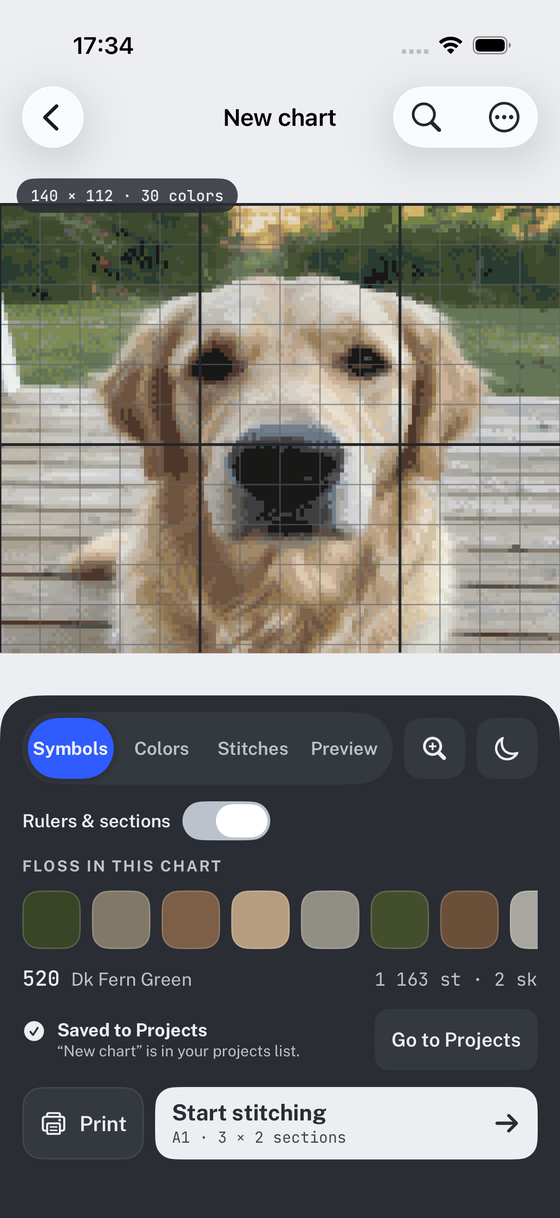
Here is one photograph converted at 140 by 112 squares, 12 colours, and then worked in three different ways. Everything except the stitch is held constant.
| How it is worked | Stitches | Hours | Needles | Thread |
|---|---|---|---|---|
| Cross stitch, as the model plans it | 15,584 | 27.7 | 528 | 237.6 m |
| Cross stitch, all full crosses | 15,584 | 25.1 | 520 | 233.8 m |
| Tent stitch over the whole canvas | 15,680 | 14.5 | 262 | 117.6 m |
Fourteen and a half hours against twenty seven and a half, for the same picture. That is not needlepoint being a lesser craft, it is one diagonal instead of two, and it is worth knowing when somebody tells you that needlepoint is the slow one.
The first row also answers a question people ask about cross stitch itself: on this chart only 96 of the 15,680 squares are left as bare cloth. The romantic idea that cross stitch is mostly fabric showing through is true of samplers and untrue of a photograph.
Finished size, which is where mesh confuses everybody
Needlepoint canvas is sold in mesh, cross stitch cloth in count, and both mean the same thing: how many stitches fit in an inch. So the same chart lands at a different size on each.
| Base | Stitches per inch | The 140 by 112 chart finishes at |
|---|---|---|
| Needlepoint 10 mesh | 10 | 14.0 by 11.2 in |
| Aida 11 count | 11 | 12.7 by 10.2 in |
| Needlepoint 13 mesh | 13 | 10.8 by 8.6 in |
| Aida 14 count | 14 | 10.0 by 8.0 in |
| Aida 18 count, or 18 mesh | 18 | 7.8 by 6.2 in |
| Petit point 22 mesh | 22 | 6.4 by 5.1 in |
Which is the same arithmetic set out at length in what the count number means. Turn it round and hold the finished size at 10 by 8 inches instead, and the work moves the other way:
| Base | Stitches to fill 10 by 8 in | Hours |
|---|---|---|
| Aida 14 count, full cross | 15,680 | 25.2 |
| Needlepoint 13 mesh, tent | 13,520 | 12.7 |
| Needlepoint 18 mesh, tent | 25,920 | 22.7 |
A coarse needlepoint canvas is genuinely quicker. A fine one is not. The hours are set by the mesh, not by the name of the craft. All of these figures are computed for cotton floss in two strands, so for wool on canvas read them as an order of magnitude rather than a promise.
Which one to start with
Start with cross stitch if you want a recognisable picture out of your first project, if you like being told exactly what to do next, or if you are working from a photograph. The counting is the whole skill and the chart carries it for you. What a first evening actually looks like is set out in the first hour.
Start with surface embroidery if you want to draw with thread, if the thing you have in mind is loose and organic, or if the idea of counting to ten repeatedly sounds like a punishment. Expect the first few pieces to look handmade in the way you did not intend.
Start with needlepoint if you want something structural: a cushion, a stocking, a chair seat. Wool on canvas is hard-wearing in a way that cotton on aida is not, which is why needlepoint ends up on things that get sat on.
None of this is a hierarchy. They share a needle, a hoop and most of a stash, and people who do one usually end up doing another.
Why cross stitch is the one you can calculate
The counted grid has a side effect that the other two do not get. Because every square is one stitch of one thread, a piece can be fully priced before any of it exists: the stitch count, the skeins, the finished inches, the hours, the number of times you will rethread the needle. Freehand embroidery cannot be costed that way, because nobody knows in advance how long a stem stitch will be.
That is the whole reason the numbers on this page exist and the reason Flossgrid can put hours next to a size while you are still choosing it. Every figure here came out of the same model, from one photograph of one golden retriever, with the stitch as the only thing changed.
Questions that come up
Is cross stitch the same as embroidery?
Cross stitch is one branch of embroidery, in the way that a sonnet is one kind of poem. When people say embroidery in contrast to cross stitch they mean freehand surface embroidery: a design drawn or traced onto plain fabric and filled with satin stitch, stem stitch, chain stitch, french knots and whatever else the piece needs. Cross stitch has one stitch and a grid to place it on. Both use the same six-strand cotton and often the same hoop.
Is cross stitch or embroidery easier for a beginner?
Cross stitch, for most people, and the reason is specific rather than sentimental. In cross stitch the difficulty is counting, which is a skill you already have. In freehand embroidery the difficulty is producing an even stitch on a blank cloth, which is a hand skill that takes weeks. Cross stitch also gives you a chart that tells you exactly what to do next. The trade is that cross stitch is slower and cannot draw a smooth curve.
What is the difference between cross stitch and needlepoint?
Both are counted, so the confusion is fair. Needlepoint is worked on a stiff open canvas, usually with wool, and it covers every hole with a tent stitch, a single diagonal. Cross stitch is worked on softer aida or linen, usually with cotton floss, uses two diagonals per square, and leaves the fabric showing wherever the chart says nothing. Needlepoint canvas is sold in mesh counts, which behave exactly like aida counts.
Can you use a cross stitch pattern for needlepoint?
Yes, and it is a common way to get patterns for needlepoint, since far more charts exist for cross stitch. The chart transfers square for square. Two things change. The finished size changes, because 13 mesh canvas is coarser than 14 count aida, so a 140 by 112 chart comes out 10.8 by 8.6 inches instead of 10 by 8. And the background has to be stitched, because bare needlepoint canvas is not a finish.
Do they use the same thread?
Cross stitch and surface embroidery both use six-strand cotton floss, DMC or Anchor, split down to the number of strands the fabric wants. Needlepoint traditionally uses wool, which is thicker and covers the canvas in one pass, though cotton and silk are both used on finer mesh. So a stash of floss serves two of the three crafts without buying anything else.