Cross Stitch for Beginners: Your First Hour
How to cross stitch is one stitch repeated: a diagonal, then a second diagonal back across it, over one square of aida. In the first hour, at a beginner pace of five stitches a minute, you place about 236 of them. That is a little over one square inch of cloth, or a block roughly 15 squares by 15.
The stitch, and there is only one
A cross stitch is two diagonals. Come up through the bottom left hole of a square, go down through the top right. Come up through the bottom right, go down through the top left. That is one stitch, and it is the entire technique of the craft.
The squares are the little woven blocks of the aida, and the holes are at their corners. One chart square equals one cross, which is the thing most people get wrong in the first ten minutes: the grid on the chart is a map of crosses, not a map of holes.
The first ten minutes, before any thread
None of this is stitching, and all of it saves an evening later.
- Cut the cloth bigger than the design. Three inches more in each direction, so a design 2.9 by 2.3 inches wants a piece around 5.9 by 5.3. That spare is what a hoop grips and what gets folded over a board at the end.
- Stop it fraying. A line of masking tape round the edge, or a zigzag on a sewing machine, or an overcast stitch by hand. Aida sheds threads for the whole life of the project otherwise.
- Find the centre. Fold in half, then in half the other way. The creases cross at the middle.
- Find the centre of the chart, marked by arrows at the middle of each edge, and put your first stitch where the two meet.
- Cut about 45 cm of floss, roughly fingertips to elbow, and pull out two strands one at a time. Two strands is standard on 14 count.
Then anchor the thread, which is the one step where the obvious answer is the wrong one. Do not tie a knot. A knot is a lump that shows through the front once the piece is stretched, and it pulls through the weave more easily than you expect. Use the loop start or an away knot instead, both of which take about the same four seconds as tying and are set out in starting a thread without a knot.
What the first hour actually contains
Here is the part nobody prints, because it needs a model rather than an opinion. Below is the same first project costed at three paces. The pace of 14 stitches a minute is what our model uses for a comfortable stitcher; five and nine are a beginner and an improving beginner, and those two are an assumption rather than a measurement, so treat them as a bracket.
| Pace | Stitches in hour one | Cloth covered | Block that size |
|---|---|---|---|
| 5 a minute | 236 | 1.2 sq in | about 15 by 15 |
| 9 a minute | 393 | 2.0 sq in | about 20 by 20 |
| 14 a minute | 560 | 2.9 sq in | about 24 by 24 |
Those figures already include rethreading, and they account for the fact that some squares on a chart take a double cross rather than a plain one, which is why 14 a minute comes out as 560 crosses an hour rather than 840. On 14 count aida there are 196 crosses in a square inch, so an hour of a beginner’s stitching is a patch a bit larger than a postage stamp.
That is the honest scale of the thing, and it is worth knowing before you start rather than after. It is also why the size of the first project matters more than anything else you will decide.
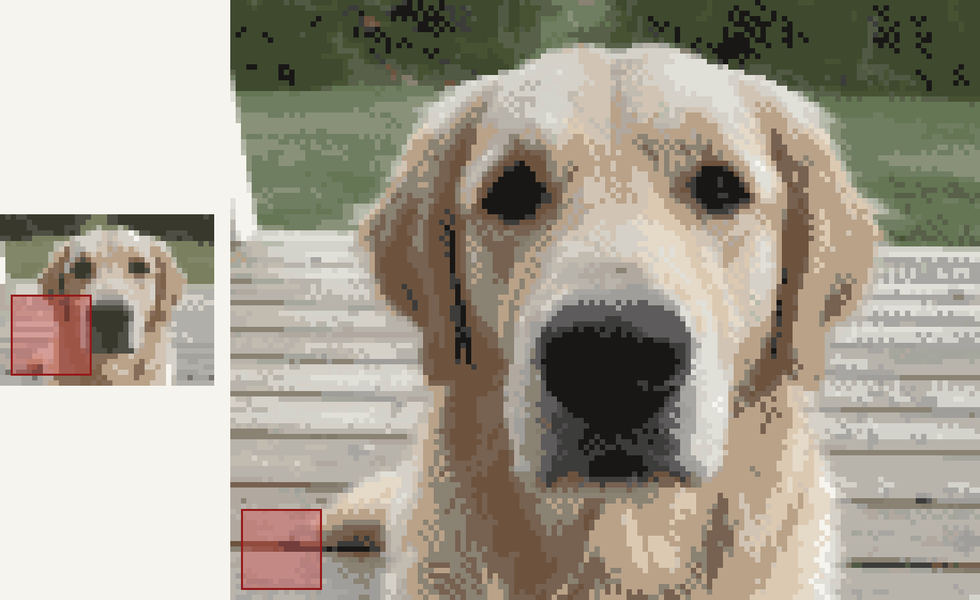
Both charts are drawn at the same scale, one square to one square. The red block is 15 by 15, the first hour. On the small chart it is a serious dent; on the large one it is a corner of the porch.
Choose a first project you will finish
The model run below is the same photograph converted at four sizes, six or twelve colours, 14 count, two strands. The last column is the total at a beginner pace of five stitches a minute.
| Grid | Stitches | Finished | Skeins | Materials | Hours at 5 a minute |
|---|---|---|---|---|---|
| 40 by 32 | 1,269 | 2.9 by 2.3 in | 6 | $3.64 | 5.4 |
| 60 by 48 | 2,857 | 4.3 by 3.4 in | 6 | $3.82 | 12.2 |
| 80 by 64 | 5,083 | 5.7 by 4.6 in | 12 | $7.33 | 21.5 |
| 140 by 112 | 15,584 | 10.0 by 8.0 in | 19 | $12.02 | 65.7 |
Forty by thirty two. That is the recommendation, and it will feel too small while you are choosing.
It is a bookmark, a card, an ornament, five evenings. Finishing it teaches you the whole craft: anchoring, counting, changing colour, running out of thread, and the specific feeling of having made a thing. The 140 by 112 portrait teaches you the same lessons and then asks for another sixty hours, and it is the single most common reason a beginner’s fabric ends up in a drawer with three inches of stitching on it.
If the picture you want is a portrait, do the small version first. The arithmetic behind that trade, and why hours grow with area rather than with width, is in how long a piece takes.
The order of the first hour
- Minutes 0 to 10. Cut, tape the edge, fold for the centre, thread the needle, anchor without a knot.
- Minutes 10 to 25. The first twenty or thirty stitches, slowly, checking the chart against the cloth after every ten.
- Minutes 25 to 55. A block of one colour. This is where the rate picks up and where the thing starts looking like something.
- The last five minutes. Finish the thread rather than leaving the needle dangling: run it under four or five stitches on the back and clip. Write down which colour you were on.
A solid block of one colour first is not laziness, it is the fastest way to see progress, and progress is what gets a beginner to the second evening.
Four things that go wrong, in order of frequency
Counting from the wrong line. Use the bold lines on the chart, drawn every ten squares for exactly this reason, rather than counting eleven squares one at a time. The rest of what a chart is telling you is in how to read a chart.
The thread twisting into a knot. You pulled two strands out of the bundle at once. Pull them out one at a time and lay them back together.
Stitches going in the wrong direction. Half of them lean left, half lean right, and the surface looks scruffy. Fix it now while it is twenty stitches.
A miscount you notice much later. One row out, discovered ten rows on, is about 1,387 stitches to unpick. That number and what to do about it are in fixing a cross stitch mistake.
What not to worry about in hour one
Tension, backstitch, fractional stitches, parking threads, railroading, whether your back is tidy. All of it is real and none of it belongs in the first evening. The back of a first piece looks like a bird’s nest and nobody frames the back. Come back to the neat version on the third project.
The sizes, hours and material costs on this page came out of the model that Flossgrid runs on, from one photograph converted at four different grid sizes with everything else held still.
Questions that come up
Is cross stitch hard for beginners?
No, and that is not encouragement, it is a description of the task. There is one stitch. It goes over one square. Every square is the same size and the chart tells you which colour goes in it. What is hard is not the stitching, it is the counting and the patience, and both of those get easier the smaller the first project is. If you can thread a needle and count to ten, the first hour will work.
How many stitches will I actually get done at first?
Around 200 to 250 in the first hour is a fair expectation, working at about five stitches a minute with pauses to look at the chart. Experienced stitchers run at roughly 14 a minute, which is 550 or so an hour once rethreading is counted. You will get faster within a single evening, and much faster over a week, mostly because you stop rechecking every square.
Where do you start a cross stitch?
In the middle. Fold the fabric in half one way and then the other, and the creases cross at the centre of the cloth. The chart marks its own centre with arrows on the edges. Match them and work outwards. Starting from a corner means that if your margin is off by six squares, you discover it at the far edge, when there is no cloth left to fix it with.
Which direction should the top diagonal go?
Whichever you like, as long as it is the same one every time. Convention is bottom left to top right first, then bottom right to top left over the top. If half the crosses lean the other way, the surface catches light unevenly and you can see it across the room. Pick a direction in the first ten minutes and stop thinking about it.
Do I need to buy a kit?
No, though a kit removes a decision at the point where decisions are exhausting. Working from your own chart is not harder, it is only more shopping: aida, a few skeins, a tapestry needle, small scissors. For one small piece that comes to a few dollars, which is the whole material cost of a first project.