How to Fix a Cross Stitch Mistake
Cross stitch mistakes come out the same way: snip from the front with the tips of small scissors, then pull the pieces from the back with tweezers. Never a seam ripper, which cuts the cloth. First decide whether it is worth it. On a 140 by 112 chart one miscounted row is 137 stitches; the same error found sixty rows later is 8,373.
Two kinds of mistake, and only one of them matters
Cosmetic. A wrong shade, a cross leaning the other way, a stitch of DMC 3033 where 3782 should have been. It sits there and does nothing to its neighbours.
Structural. A miscount. You put a row in one square out, and every stitch placed after it inherits the error. Nothing looks wrong at first, which is exactly the problem.
The first kind you can usually leave. The second kind gets more expensive every evening you do not notice it, and that is what the rest of this page is about.
What a miscount costs
Below is the same chart used throughout these articles: a portrait 140 squares by 112 on 14 count, 12 colours, 27.7 hours of work in total. Suppose the miscount happens in row 40. The cost of fixing it is everything stitched since, because everything since is one square out.
| Noticed | Squares to remove | Stitches | Time it took to put in | Thread lost |
|---|---|---|---|---|
| Same row | 140 | 137 | 17 min | 2.3 m |
| 5 rows later | 700 | 687 | 1.2 h | 10.6 m |
| 10 rows later | 1,400 | 1,387 | 2.3 h | 19.9 m |
| 20 rows later | 2,800 | 2,787 | 4.3 h | 37.6 m |
| A whole section later, 60 rows | 8,400 | 8,373 | 13.2 h | 114.2 m |
Seventeen minutes, or thirteen hours. Same error. The only variable is when you looked.
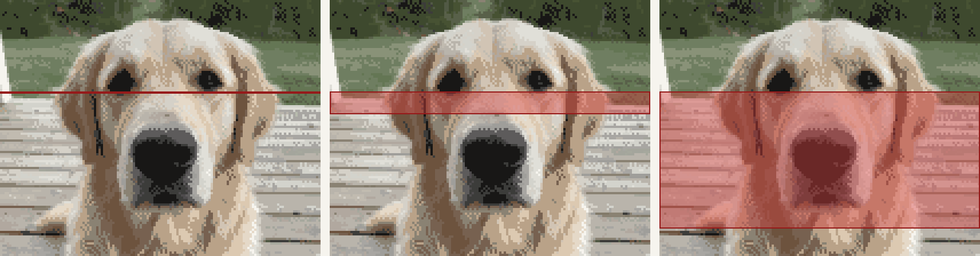
Those hours are what the model says it took to put the stitches in. It does not price the unpicking, because we have no measured rate for that. Removing is slower than stitching, so treat that column as a floor.
Why you do not notice
Here is the same chart with everything below the line shifted by a single square. Left is correct, right is the miscount.
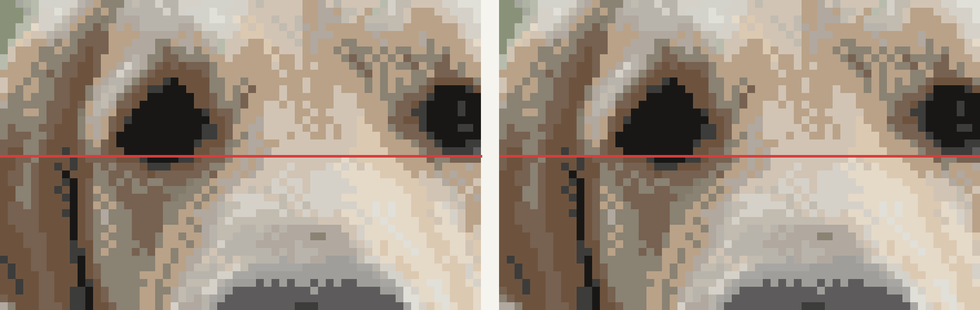
You can see it if you are told where to look. Nobody is told where to look. A one square offset does not read as an error, it reads as a slightly different picture, and it stays invisible until it meets something it has to line up with: the other side of a face, a border, the edge of the cloth. That is usually several evenings later, which is precisely the row of the table you do not want.
The cheapest insurance there is
Check at every bold line. The heavy lines on a chart are drawn every ten squares, and if you compare cloth to chart each time you cross one, the worst case is a block of ten by ten.
On this chart that block holds 87 stitches and about eight minutes of work. Eight minutes against thirteen hours is the whole argument, and it costs you about two seconds of looking every ten squares. What else the bold lines and the legend are for is in how to read a chart.
Two more habits that pay for themselves:
- Work outwards from the centre. An error started in the middle stays local; an error started in a corner compounds all the way across and you find out when the design runs off the cloth.
- Grid the fabric before you start. A line of tacking thread every ten squares, in a colour you can see, pulled out at the end. It costs part of an evening on a large piece and turns counting into looking.
Working in sections helps for the same reason: a section boundary is a natural place to compare the whole block against the chart before moving on. A 140 by 112 chart splits into six sections of about 50 by 60, and each of those holds 2,987 stitches and 4.7 hours, which is the most one section boundary can let you lose. More on sections and pacing in how long a piece takes.
How to actually take stitches out
- Work in daylight. This is fiddly and every mistake here costs cloth.
- Snip from the front. Slide the tip of small sharp embroidery scissors under one arm of a cross and cut it. Work across the area, cutting rather than pulling.
- Pull from the back with tweezers. The cut pieces come away in short lengths. Short is what you want: a long thread dragged out through the weave distorts it.
- Do not use a seam ripper. Its blade travels in the plane of the fabric and on aida it will cut a block of the cloth, which is not repairable.
- Lint roller or tape for the fluff left behind, which there will be a surprising amount of.
- Do not reuse the thread. It has been through the cloth twice and it is worn out. Cut a fresh length.
If you removed a lot, run a fingernail over the area or press it lightly from the back before restitching, so the holes close up and stop showing where the old stitches were.
Anchoring the replacement
Do not tie a knot in the new thread, especially not here. Unpicked areas are already thin on cloth and a knot on the back of a repaired patch is the one most likely to pull through. Anchor under the surrounding stitches with an away knot, which works with any number of strands, as set out in starting a thread without a knot.
The other mistakes, briefly
Ran out of a colour mid piece. Buy more, but expect the dye lot to differ slightly. If the number is one that carries the piece, and the join would fall in a flat area like a sky, work the remainder of the old skein and the new one alternately for a few rows so the change is a blur rather than a line.
Thread keeps knotting. You pulled two strands out of the bundle at once. Separate them one at a time and lay them back together.
Back is a mess. Leave it. Long jumps between distant areas are worth avoiding on pale cloth because they show through, and that is the only reason to care.
Started too big. The most common and least discussed. Nothing is wrong with the stitching, the piece is simply larger than the evenings available. Finishing a small one first is the fix, and what a realistic first size looks like is in the first hour.
When to leave it alone
Hold the work at arm’s length. Then put it on the far side of the room and look at it from there, because that is where it will be seen from for the rest of its life.
If the mistake has disappeared, it has disappeared. A shade one step out in a background, a single cross of the wrong number in a field of thousands, a slightly uneven line of backstitch: none of these survive the walk across the room, and unpicking them buys nothing but the knowledge that they are gone.
Save the frogging for the errors that move everything after them. Those are the ones with a real number attached, and the number is on this page.
Every count and every hour here was produced by the model that Flossgrid runs on, from the same conversion of the same photograph, with the region to be removed measured square by square rather than estimated.
Questions that come up
What is frogging in cross stitch?
Unpicking. The joke is that the work says rip it, rip it, which sounds like a frog, and the name stuck hard enough that shops sell frog charms to stitchers who have had a bad week. It is not a technique, only a word for taking stitches out, and it has the useful side effect of making the thing sound survivable, which it is.
How do you unpick cross stitch without ruining the fabric?
Turn the work face up, slide the tip of small sharp scissors under a stitch and snip it, working across the area you are removing. Then turn it over and pull the cut pieces out from the back with tweezers. Do not use a seam ripper: its blade sits in the same plane as the cloth and on aida it will cut a block before you feel it. Do not pull long stitches out whole either, because the drag distorts the weave.
Do I have to unpick a wrong colour?
Look at it from across the room first. If two shades of the same family are a step apart and the area is small, nobody will ever see it, and you will not see it either once it is framed and on a wall. Unpick when the mistake is structural, meaning it moves everything after it, or when it is dark against light where the eye lands. A wrong tone in a background is a decision you get to make; a row that is out by one square is not.
My fabric is puckered. Can that be fixed?
Usually, yes, and not by unpicking. Puckering is almost always tension: stitches pulled tighter than the cloth wants, so the aida is gathered around them. Washing the finished piece by hand and pressing it face down while damp relaxes most of it out. What does not come back is fabric distorted by stitching a stretchy garment without a stabiliser, which has to be prevented rather than repaired.
What if I have already stitched half the piece on the wrong count?
Then finish it on the wrong count. The design will be a different size from the one you planned, which affects the frame and nothing else. Restarting costs you everything already stitched, and the only thing you gain is a piece that matches a number you wrote down weeks ago. Measure what you have, buy the frame to fit, carry on.