What to Buy to Start Cross Stitch, and What Not To
What you need to start cross stitching is five things: aida, floss, a blunt tapestry needle, small sharp scissors and a chart. For a first project of 40 by 32 squares the model puts the whole material bill at about $3.64. You do not need a frame stand, a magnifier, a thread organiser or 24 colours.
The list, and it is short
- Aida, 14 count, white or cream. Cut three inches larger than the design in each direction.
- Floss. DMC or Anchor six-strand cotton, one skein per colour in the chart.
- A blunt tapestry needle, sized to the count. See below.
- Small sharp scissors. Embroidery scissors, not the kitchen pair.
- The chart, on paper or on a screen.
Optional and genuinely useful: a hoop. Optional and not useful yet: everything else in the shop.
What that costs
The table is a model run: the same photograph converted at four sizes on 14 count aida, two strands, with the shopping priced at about 55 cents a skein and about a penny per square inch of cloth.
| Project | Squares | Colours | Skeins | Floss | Cloth | Total |
|---|---|---|---|---|---|---|
| First piece, 40 by 32 | 1,280 | 6 | 6 | $3.30 | $0.34 | $3.64 |
| A card, 60 by 48 | 2,880 | 6 | 6 | $3.30 | $0.52 | $3.82 |
| A cushion front, 100 by 80 | 8,000 | 12 | 13 | $7.15 | $0.97 | $8.12 |
| A portrait, 140 by 112 | 15,680 | 12 | 19 | $10.45 | $1.57 | $12.02 |
Three dollars and change for a first project. This is worth saying plainly, because anxiety about buying the wrong thing is out of all proportion to the sums involved. A large piece is sixty hours of your life and twelve dollars of materials. Nothing you buy wrong at this stage is expensive; the expensive mistake is stitching forty hours of something that was never going to work.
The one purchase that actually has a cost: colours
Every colour in a chart needs at least one whole skein, because a skein is the smallest unit a shop sells. So the palette, not the size, is what sets the shopping list on a small piece.
Here is one 60 by 48 chart with the colour limit as the only thing changing. The stitch count barely moves. The bill does.
| Colours | Skeins | Floss cost | Stitches | Smallest colour, in squares |
|---|---|---|---|---|
| 3 | 3 | $1.65 | 2,850 | 660 |
| 6 | 6 | $3.30 | 2,857 | 161 |
| 9 | 9 | $4.95 | 2,865 | 100 |
| 12 | 12 | $6.60 | 2,869 | 73 |
| 18 | 18 | $9.90 | 2,871 | 37 |
| 24 | 24 | $13.20 | 2,870 | 18 |
At 24 colours, the smallest number in the chart occupies 18 squares and costs a whole skein of which you will use about a third of a metre out of 24. That is the mechanism by which a stash appears, and it is set out in full in how much floss a piece really needs.
For a first project, six colours is plenty and three is not embarrassing.
Needle size, which follows the cloth
The needle has to pass through the hole without forcing it and carry the strands the cloth wants. Both of those are set by the count, so the count picks the needle for you. The middle column is the physical size of one square, which is what your needle is actually going through; the last column is the standard trade sizing, where a higher number means a finer needle.
| Count | One square measures | Strands, full cross | Strands, backstitch | Tapestry needle |
|---|---|---|---|---|
| 11 | 2.31 mm | 3 | 2 | 22 or 24 |
| 14 | 1.81 mm | 2 | 1 | 24 |
| 16 | 1.59 mm | 2 | 1 | 24 or 26 |
| 18 | 1.41 mm | 2 | 1 | 26 |
| 22 | 1.15 mm | 1 | 1 | 26 or 28 |
| 28 over one | 0.91 mm | 1 | 1 | 28 |
Two things about tapestry needles that nobody tells beginners. They are blunt on purpose, so a needle that feels like it should be sharper is the right one. And they wear out: the plating on the eye roughens with use and starts shredding floss, so a needle that has become hard to thread is not your eyesight, it is the needle.
Working over two on linen or evenweave? Halve the label first and read the row for the resulting stitches per inch, for the reasons set out in what fabric to use.
Hoop size, if you use one
The rule is that the ring should never sit on finished stitching, because it crushes the crosses and leaves a mark that only a wash takes out. So buy a hoop bigger than the diagonal of the design, not bigger than its width.
| Design | Diagonal | Smallest hoop that clears it |
|---|---|---|
| 40 by 32 squares | 3.7 in | 4 in |
| 60 by 48 squares | 5.5 in | 6 in |
| 100 by 80 squares | 9.1 in | 10 in |
| 140 by 112 squares | 12.8 in | no ordinary hoop |
Above about 10 inches you are into scroll frames or into moving the hoop and accepting the marks, which is one more argument for keeping a first piece small. The rest of that argument, in hours, is in what the first hour actually contains.
Where to buy
Any craft shop with a haberdashery section stocks aida and DMC by the skein, and that is the cheapest way to buy exactly what one chart needs. Online is better for a specific list of numbers and worse for judging cloth colour.
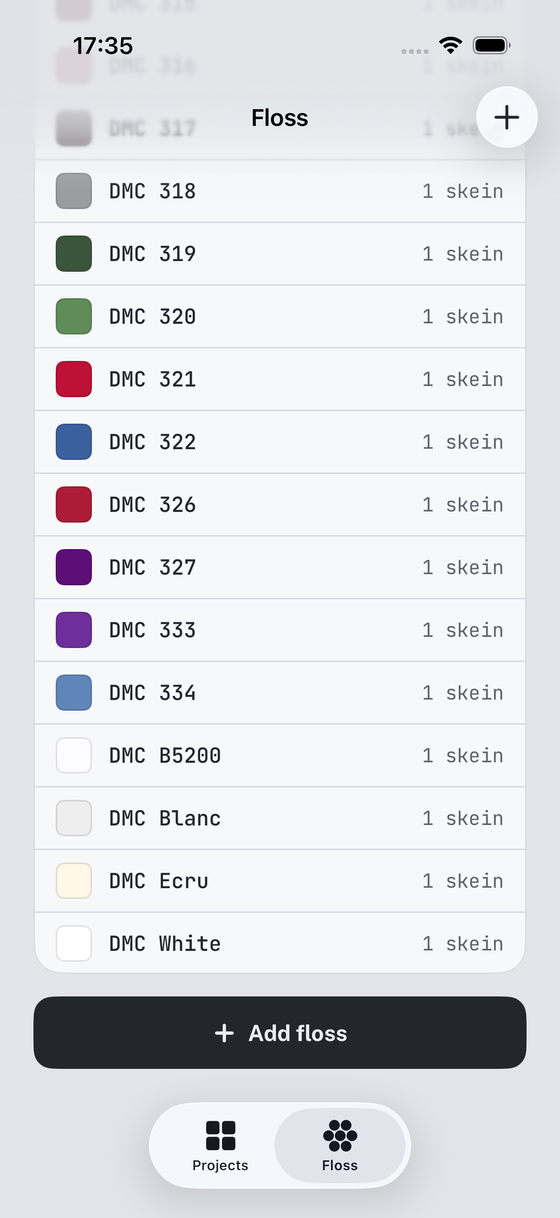
Starter sets of assorted floss are tempting and mostly a bad deal for a first project: 24 assorted numbers is about $13.20 and none of them is necessarily the six your chart asked for. Buy to the list. The set makes sense later, when you are building a stash on purpose rather than by accident.
After the second project
This is roughly the order in which the extras start earning their place.
- Sharp embroidery scissors, if you skipped them. First.
- A hoop or a small frame, once you notice your tension changing.
- Bobbins or floss drops, once you own enough numbers to lose one. Filed by number rather than by shade, for the reason set out in how to store floss.
- A daylight lamp, at the point where you are stitching in the evening and blaming your eyes.
- A magnifier, only if you move above 16 count.
None of that belongs on the first receipt.
The costs, skein counts and cloth sizes on this page were computed by the model that Flossgrid runs on, from real conversions of one photograph at four sizes and six palettes. The tapestry needle numbers are the standard trade sizing rather than our arithmetic; what our model gives is the millimetre they have to fit through.
Questions that come up
What size cross stitch needle do I need for 14 count aida?
A size 24 tapestry needle, which is the default for 14 and 16 count. Sizes run backwards, so a bigger number is a finer needle: 22 or 24 on 11 count, 24 on 14, 26 on 18, 28 on 22 and finer. The needle must be blunt, because it passes between the threads of the cloth rather than through them, and it needs an eye large enough to take two strands without shredding them. A pack of assorted sizes costs a couple of dollars and settles the question permanently.
Do you need a hoop for cross stitch?
No. Plenty of people stitch in hand and get a more relaxed tension for it, and aida is stiff enough to hold its own shape. A hoop helps if you pull tight or if the cloth is soft, and it makes the holes easier to find. If you use one, buy it larger than the diagonal of the design so the whole thing fits inside without the ring ever sitting on finished stitches. A 4 inch hoop covers a first project of 40 by 32 squares.
Are cross stitch kits worth it?
For a first project, often yes, and not because the materials are better. A kit removes four decisions at the moment when decisions are what stop people starting. What you lose is choice of subject and the ability to change the size. Once you know you like this, buying separately is cheaper and gives you a stash that serves the next piece too.
How much floss should I buy?
One skein per colour in the chart, plus one spare of the two or three numbers that carry the piece. There is no point buying more, because a skein is 8 metres of six-strand cotton and a small chart uses a fraction of it. The trap is the number of colours rather than the amount: every colour costs a whole skein however few stitches it has, so a palette of 24 is mostly buying skeins you will barely touch.
What can I skip at the start?
A floor stand, a magnifying lamp, a laying tool, a thread organiser, a needle minder, a project bag and a highlighter set. All of them are genuinely useful on the fifth project and none of them do anything for the first. The one cheap thing worth adding early is a small pair of sharp embroidery scissors, because cutting floss with kitchen scissors leaves a frayed end you then cannot thread.