How to Separate, Wind and Store Cross Stitch Floss
Cut about 45 cm, pull the strands out one at a time straight upwards, then lay back together the number your fabric count wants. Store by DMC number rather than by colour, because that is what a chart asks for. Most of a stash is leftovers: a 29 colour chart buys 720 usable metres and puts only 260 into the work.
What is in a skein, and what you get out of it
A standard DMC skein is 8 metres of six-strand cotton. Six strands, twisted together, meant to be pulled apart. So the useful number depends entirely on how many you stitch with:
| Strands in the needle | Usable length from one skein |
|---|---|
| 1 | about 48 m |
| 2 | about 24 m |
| 3 | about 16 m |
Two strands covers most cross stitch, so 24 metres is the figure worth remembering.
Cutting and separating
Cut about 45 cm. The old measure is fingertips to elbow, which is close enough and does not need a ruler.
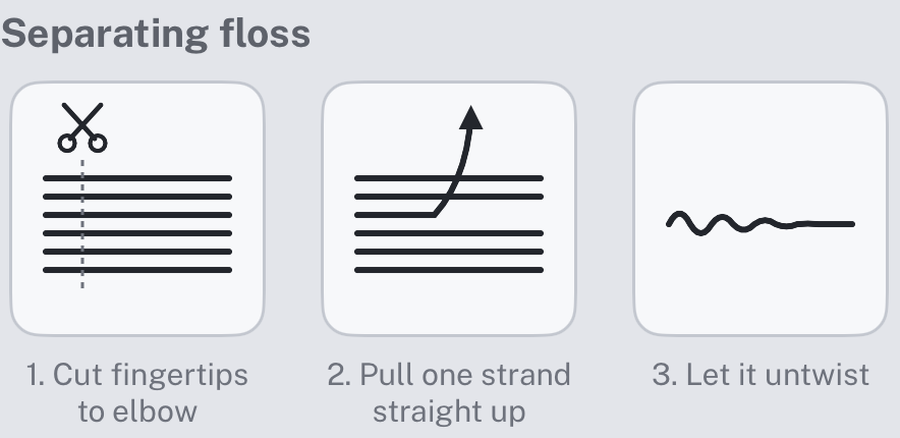
Then take the strands out one at a time, straight upwards, and let each one untwist as it comes free. Lay the number you want back together afterwards.
This is the bit people skip, and it is the whole trick. Pulling two strands at once twists them around each other on the way out of the bundle, and that twist is what turns into a knot forty stitches later. Separating and relaying takes about five seconds and it also makes the stitch lie flatter, because the two strands sit side by side instead of wound together.
How many strands
Coarser cloth needs more thread in the needle or the fabric shows through between the arms of the cross.
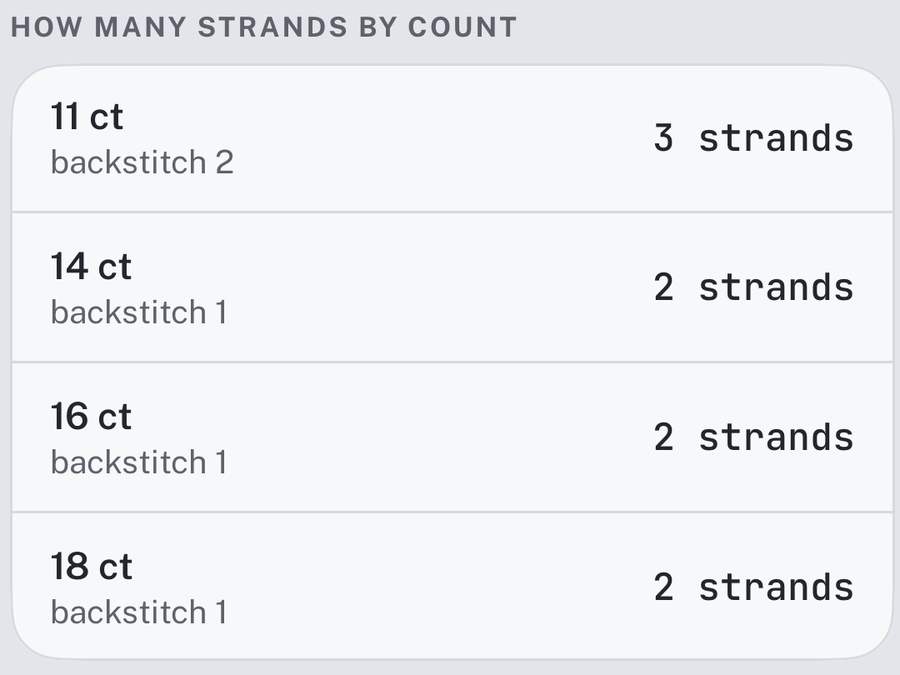
Backstitch goes one strand lighter than whatever the block stitching uses, so it reads as a line rather than a rope. Evenweave and linen worked over two threads behave like half their count, so 28 count over two takes two strands, not one. That over-two rule turns up in several places and is set out with the rest of the sizing in what fabric count actually means.
Where a stash actually comes from
Here is the arithmetic almost nobody does, and it explains the box in the cupboard better than any tidying advice.
Take one portrait, 140 by 112 stitches on 14 count, two strands, built from the full DMC range. It uses 29 numbers and the shopping list is 30 skeins. Thirty skeins at 24 usable metres is 720 metres bought. The chart actually consumes 260 metres. The other 460 metres, 64 per cent of what you paid for, goes back in the box.
It gets sharper. Of those 29 numbers, 28 need exactly one skein, because a skein is the smallest unit a shop sells. The smallest colour on that chart appears 57 times and takes 1.0 metre of thread out of a 24 metre skein.
The same photo limited to 12 colours needs 19 skeins, buys 456 metres, uses 302, and leaves 154. Still a third left over, but a third of a much smaller number.
A stash, in other words, is not something you accumulate by being disorganised. It is the necessary residue of the one-skein minimum, and the honest response is not to feel bad about it but to start using it. Which brings us to storage.
Storing so that the box is usable
Three things make the difference, and none of them is the container.
File by number. A chart asks for DMC 3363 and nothing else. A drawer sorted by eye cannot answer that question, and there are 456 numbers in the DMC range with a great many near-identical browns among them. Number order is the only index that matches the query.
Keep the number attached to the thread. This is the actual argument for bobbins: not tidiness, but that a loose length of brown floss with no band on it is worthless, because you can never again be sure which brown it is. Wind onto bobbins and write the number on, or keep the paper bands and use labelled bags, or use floss drops on rings. Any of them works. Cardboard bobbins wound tight do leave a crease every few centimetres, so wind them loosely or buy plastic.
Write down what is in there once. It also stops you re-buying numbers you own, which is most of what not to buy. This is the part that changes what you stitch rather than how you store it. Once you know the drawer holds, say, 24 numbers, a chart can be built from those numbers instead of from 456 possibilities, and the shopping list stops being a list of thirty things.
The dye lot problem
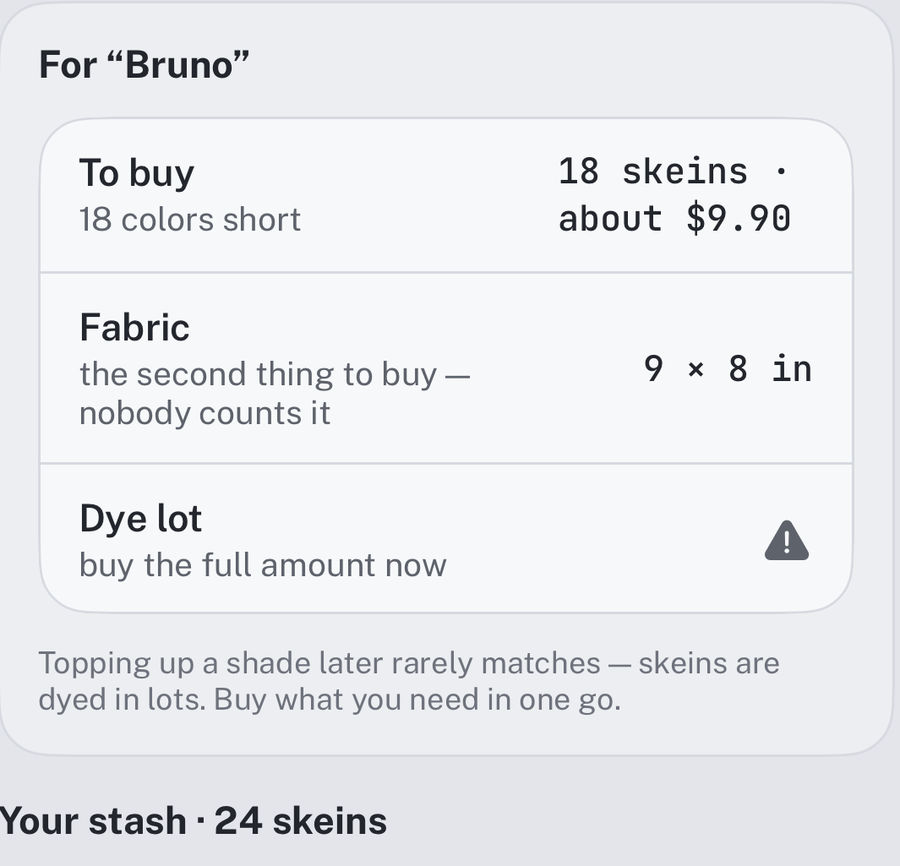
One thing that is worth being fussy about. Skeins are dyed in lots, and two skeins of the same number from different lots can differ enough to show as a band across a sky. So on the two or three numbers that carry the piece, buy the whole amount at once rather than topping up in a month.
For a number that appears in forty stitches, none of this matters. You will never notice, and you already own more of it than you think.
Cutting the list before you cut the thread
The cheapest thing you can do to your shopping list is decide the palette deliberately rather than accepting whatever a converter suggests. Twenty-nine colours to twelve took this piece from 30 skeins to 19 with almost no visible change, and it also took the stray single stitches from 106 down to 25, which is a whole separate saving in evenings. The full skein arithmetic, including the tails you never see on the front, is in how much floss a piece really takes.
The lengths and leftovers on this page were computed by the model that Flossgrid runs on, from one real conversion of one photograph, and the app subtracts your stash from the list before it tells you what to buy.
Questions that come up
How do you separate embroidery floss without it tangling?
Cut the length first, then hold the cut end lightly and pull one single strand straight upwards, letting the rest slide down and untwist as it goes. Do it one strand at a time even when you need two, and lay the two back together afterwards. The instinct to grab two at once is what produces the knot: two strands pulled together twist around each other on the way out. If the remaining bundle bunches, let go, let it hang, and it will drop free.
How long should you cut floss for cross stitch?
About 45 cm, which is roughly from your fingertips to your elbow. It is a compromise. Longer means fewer thread starts, but the thread is dragged through the fabric more times and gets fluffy and thin at the needle end, and it tangles behind the work. Shorter is cleaner and costs more time: at 45 cm a 140 by 112 portrait already needs about 528 separate needles, and each one is roughly 45 seconds of cutting, splitting, threading and anchoring.
Are floss bobbins worth winding?
They are worth it once you own more than a few dozen numbers, because a bobbin is flat, stackable and printable with the number, and loose skeins in a bag are not. The objection to cardboard bobbins is real: wound tight, they leave a crease every few centimetres that never quite comes out. Plastic bobbins crease less. Floss drops on a ring avoid the problem entirely and cost more. If you keep the paper bands on and the skeins in labelled bags, that also works, and it is free.
Should floss be organised by colour or by number?
By number. A chart never says apricot, it says DMC 3341, and the only question you ever ask a drawer is whether that number is in it. Sorting by shade looks lovely and fails on the one job it has, because the sixteen browns near each other in the box are eight numbers apart in the catalogue and you will pick the wrong one under a lamp. If you want the pretty version, sort by number and let the numbers fall into families, which they mostly already do.
How should floss be stored so it stays good?
Out of sunlight, out of damp, and away from dust. Cotton floss is stable stuff and the usual failure is not fading, it is a box left open in a room that gets sun on one shelf, which bleaches the top row over a couple of years. Closed boxes or drawers solve it. Do not seal damp thread in plastic. And keep the dye lot in mind on anything you are part way through: topping a shade up later rarely matches exactly.