Cross Stitch Confetti and How to Get Rid of It
Confetti is a square of one colour with nothing of the same colour touching it on any of its eight sides. Each one costs you a fresh needle, a stitch, and an anchor. The count is set almost entirely by how many colours you allowed: on one demo photo, 30 colours produced 106 of them and 12 colours produced 25.
What counts as one
A confetti stitch is a square whose eight neighbours, including the diagonals, are all a different colour. Diagonals matter: a proper dithered checkerboard looks speckled but every square has company on the diagonal, and it works up as ordinary shading rather than as a hundred separate thread starts.
The picture below is a real conversion, and every square the model counted as alone has a ring drawn round it. Same photo, same 140 by 112 grid, same 14 count aida, same stitch types. Only the colour limit changed.
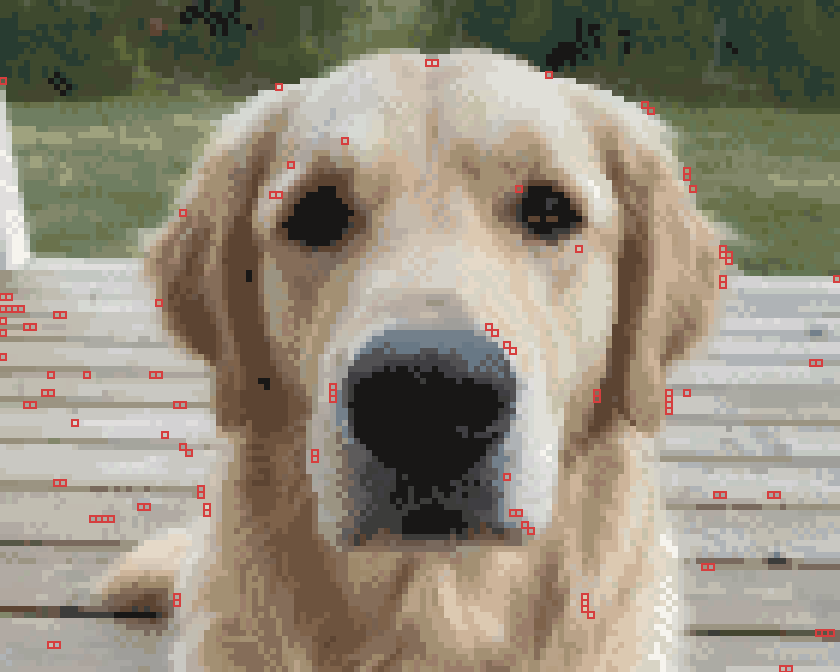
Thirty colours: 106 rings.
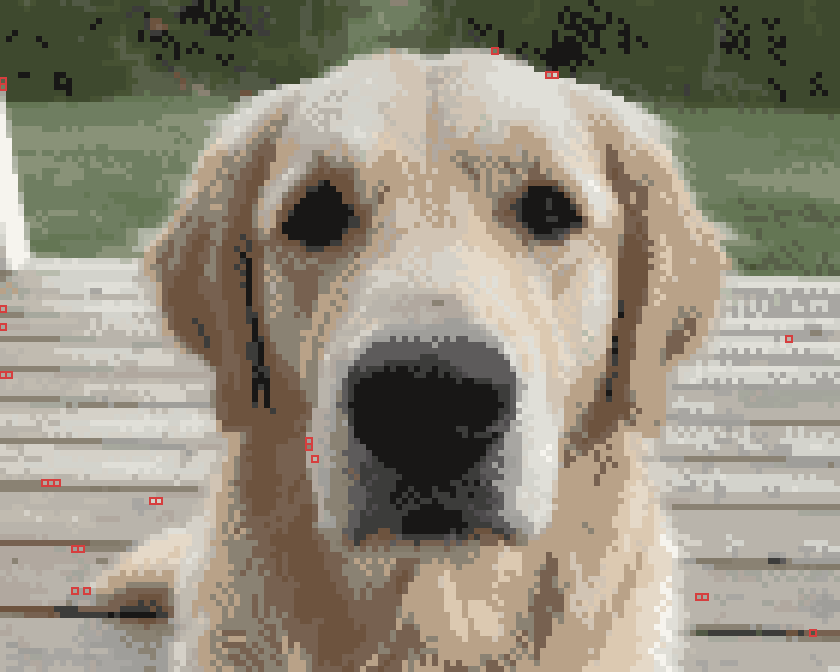
Twelve colours: 25 rings.
The sweep
Here is the same photograph converted nine times, with the colour limit as the only thing that moved. Everything else is held: the grid, the fabric, the strands, the stitch types available, the amount of shading allowed.
| Colours | Single stitches | Average run, squares | Skeins | Hours | Colour error |
|---|---|---|---|---|---|
| 4 | 3 | 3.49 | 14 | 25.2 | 7.8 |
| 6 | 16 | 4.25 | 16 | 27.9 | 6.1 |
| 8 | 54 | 3.70 | 16 | 27.0 | 5.0 |
| 10 | 64 | 3.06 | 17 | 27.6 | 4.7 |
| 12 | 25 | 3.21 | 19 | 27.7 | 4.6 |
| 16 | 68 | 2.57 | 22 | 28.3 | 4.1 |
| 20 | 71 | 2.51 | 24 | 28.8 | 3.8 |
| 24 | 70 | 2.41 | 27 | 28.8 | 3.7 |
| 30 | 106 | 2.26 | 32 | 28.6 | 3.6 |
The single stitch column is not a straight line, and it would be dishonest to pretend otherwise. Twelve colours came out better than ten and better than eight. What is going on is that the conversion has a cleaning pass: where a stray square can be swapped for one of its neighbours without anyone seeing the difference, it is. How much of that is possible depends on whether a close enough neighbour tone happens to exist in the palette, and that is luck as much as arithmetic.
The average run column is the one to trust, because it is monotone and it is the thing your hands feel. It is how many squares of one thread you get, on average, before the colour changes on you. At six colours you get 4.25 squares. At thirty you get 2.26. Half the run length, twice the thread changes, for a colour error that improved from 6.1 to 3.6 in units nobody can see on aida from a metre away.
Where confetti actually lives
The folklore says confetti comes from busy backgrounds. On this photograph it is the other way round.
Of the 106 stray stitches at thirty colours, 15 were in the out of focus grass and 91 were below it, on the sunlit porch boards and the dog’s muzzle. The grass is visually busy but tonally coarse, so the chart settles into patches. The decking is smooth, pale and slowly graded, which is exactly the condition where the nearest thread flips between two numbers square by square.
That reframes the fix. What causes confetti is a smooth gradient, wherever it happens to be: a clear sky, a studio backdrop, a wall behind a head, a cheek in soft light, or the fake blur a phone’s portrait mode paints in. A leafy hedge is a different problem, which is that it eats half your palette, and worth handling for its own reasons at the photo stage.
The four fixes, in order of how much they help
Use fewer colours. Nothing else comes close. Thirty to twelve took 106 stray stitches to 25 and the shopping list from 32 skeins to 19, at a cost of nothing you can see across a room.
Remove or flatten the smooth area. Blur it further so it flattens into one tone, crop it out, or leave it as bare fabric. A background stitched in one colour, or not stitched at all, is a legitimate design decision rather than a shortcut, and it is what most commercial pet portraits do.
Let stitch density carry the tone instead of another colour. Nothing, a seed stitch, a backstitch, a half cross, a full cross, a double cross: six steps out of one thread. Worked in a single number, this photograph produces no confetti at all, because with one colour there is nothing to flicker between. It costs 19.2 hours and 9 skeins of DMC 310, and it is not for every subject, but on a dark-eyed animal it is startlingly good.
Accept it and change how you stitch. Which is the next section.
Working a chart that already has it
Sometimes the chart is bought, or the confetti is in the face where it belongs. Then the answer is technique rather than design.
- Work a small block in every colour it needs before moving on, rather than one colour across the whole piece.
- Park threads instead of finishing them. Bring the needle up at the next square that colour appears in, leave it dangling on the front, and pick it back up when you get there.
- Cut shorter lengths than usual. You will be anchoring far more often, and a long thread that has been dragged across the back forty times looks tired.
- Anchor without knots. A confetti area is a hundred thread starts, and a hundred knots on the back is a lumpy piece. The loop start and the away knot are both quicker than tying anyway, and they are set out in starting and finishing without a knot.
The cost is real and it is worth putting a number on before you start. On the twelve colour version of this chart the model counts 528 separate needles and 6.6 hours of threading, against 21.1 hours of actual stitching. Confetti moves work out of the first column and into the second, which is the part that feels like wasted evenings even though the totals barely move.
Every count on this page was produced by the model that Flossgrid runs on, from the same photograph converted nine times with the palette as the only variable, and the rings in the two pictures mark the exact squares it counted.
Questions that come up
What is confetti in cross stitch?
Single stitches of one colour scattered across an area, with nothing of the same colour beside them. The name is affectionate and the feeling is not. They happen because the chart matched each square to its nearest thread independently, and in a smooth gradient the nearest thread flips back and forth between two numbers from one square to the next. Every one costs a thread start and a thread finish for a single cross, which is why fifty of them feel like five hundred stitches.
Does confetti mean the pattern is bad?
Not on its own. Detailed portraits and reproductions of paintings genuinely need mixed tones, and a designer who has thought about it will keep the confetti in the places you look at, such as an eye, and out of the places you do not. It is bad when it is accidental, which is what a photo converter produces by default: a few hundred stray stitches spread through a blurred background nobody will ever examine.
How do you stitch a chart that is full of confetti?
Stop working one colour at a time. Pick a small block, perhaps ten squares by ten, and do every colour inside that block before moving on, which is usually called cross country. Park threads rather than finishing them: bring a needle up out of the way at the next square that colour appears in, leave it hanging, and come back to it. Use shorter working lengths than you would elsewhere, because you will be starting and stopping constantly.
Will using more colours ever reduce confetti?
Almost never in a smooth area, and that is the counterintuitive part. Adding a colour between two that were flickering gives the chart a third option to flicker to. Across a sweep of the same photo, the average unbroken run of one thread along a row fell steadily from 4.25 squares at six colours to 2.26 at thirty. More numbers buys a closer colour match and pays for it in changes of thread.
Can you just leave the odd single stitch out?
Often, yes. Look at the chart at about an inch wide: if a stray stitch is invisible at that size, it will be invisible on the wall, and replacing it with whatever surrounds it costs nothing. This is what a despeckling pass does automatically, and doing it by eye on a printed chart with a pencil before you start is a reasonable evening's work on a big piece.