How to Print a Cross Stitch Pattern at Home
Print at full size and let it run over several sheets. A square below 4 mm on paper stops being countable, and at 4 mm a US Letter sheet holds 45 by 61 squares. So a 140 by 112 chart is 8 sheets plus a legend page, whatever fabric count you plan to stitch it on.
One number decides the whole thing
A square on paper has to be about 4 mm for the chart to work. Below that you can still see it, but you stop being able to count a run of twelve without losing your place, and a triangle and a diamond at 1.3 mm are the same small smudge. Everything else here follows from that one measurement.
A US Letter sheet is 215.9 by 279.4 mm. Take 12.7 mm of margin off each edge, because printers do not print to the paper edge, and another 8 mm strip for the row and column numbers. What is left is 182.5 by 246.0 mm, which at 4 mm a square is 45 by 61 squares, or 2,745 of them, per sheet.
A4 works out at 44 by 65, so 2,860 squares. Slightly more per sheet, a different shape, and that difference is worth something on big charts.
What that means for a real chart
Here is the export from a 140 by 112 chart, which is the canonical size on this site: 10 by 8 inches on 14 count aida.
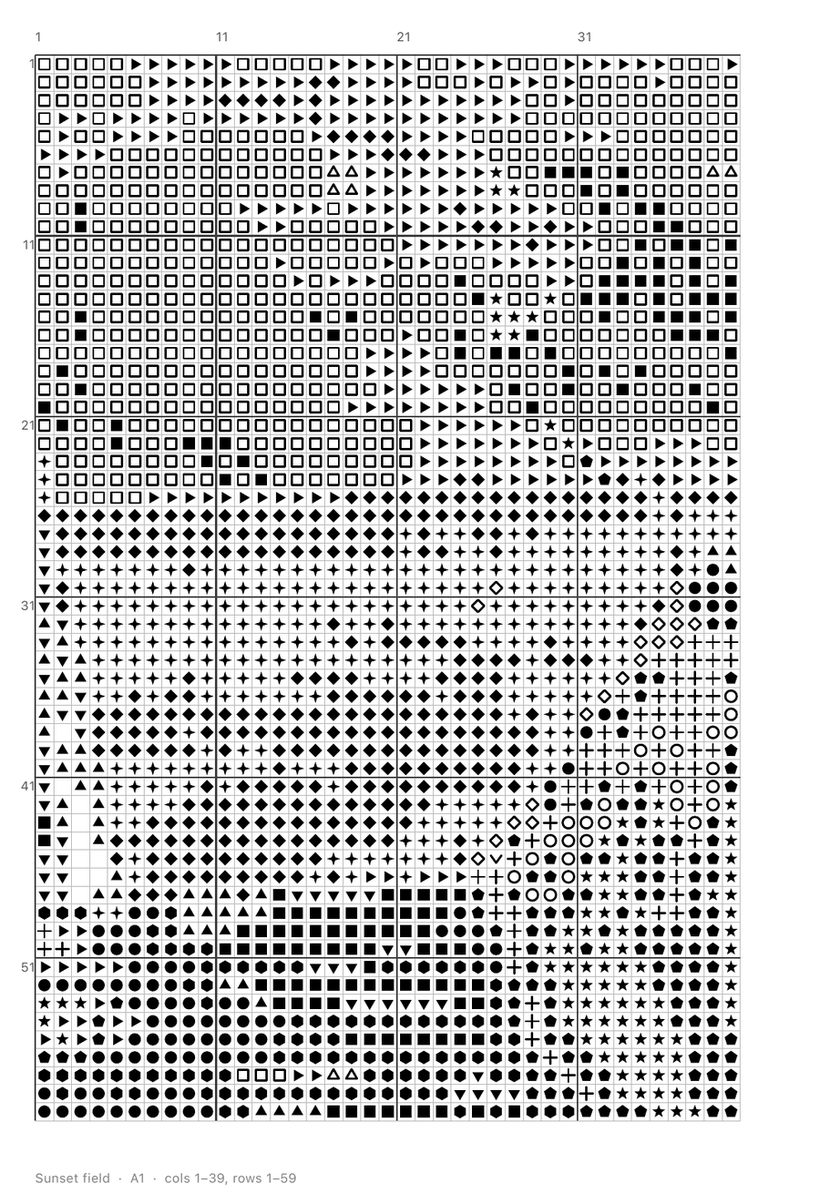
That is sheet A1. The footer says which columns and rows it holds, cols 1 to 39 and rows 1 to 59, because the sheet capacity of 45 by 61 gets trimmed down to an even layout so there is no runt column at the right hand edge. Four sheets across, two down, eight sheets, plus the legend on its own page. Nine sheets in total.
The count does not change the number of sheets
This is the part people expect to be false.
| Fabric count | Finished piece | Sheets of paper |
|---|---|---|
| 11 | 12.7 by 10.2 in | 9 |
| 14 | 10.0 by 8.0 in | 9 |
| 16 | 8.8 by 7.0 in | 9 |
| 18 | 7.8 by 6.2 in | 9 |
| 22 | 6.4 by 5.1 in | 9 |
| 28 over one | 5.0 by 4.0 in | 9 |
The finished piece halves in area between 11 count and 22 count. The paper does not move at all, because paper is cut by squares and cloth is cut by inches. Choosing 18 count to save on printing is a decision that saves nothing, and the count decision belongs to the finished size instead.
One more consequence: the printed chart is nearly always larger than the thing you are stitching. At 4 mm a square, paper runs at 6.35 squares to the inch, so that 140 by 112 chart is 22 by 17.6 inches of paper for a piece finishing at 10 by 8.
Where a chart stops fitting on one page
| Chart | Letter sheets | A4 sheets |
|---|---|---|
| 45 by 61 | 1 | 2 |
| 46 by 61 | 2 | 2 |
| 84 by 70 | 4 | 6 |
| 140 by 112 | 8 | 8 |
| 240 by 180 | 24 | 21 |
| 300 by 240 | 40 | 32 |
Forty five by sixty one is the exact edge. One square more across and you are taping. That is bookmark and keyring territory; anything you would call a project is a multi sheet print.
Letter also beats A4 on small charts and loses badly on big ones, because A4 is narrower and much taller. On a 300 by 240 chart that is eight sheets.
Why shrinking never works
The obvious move is to scale the chart down until it fits. Here is what that actually costs on the 140 by 112:
| Square on paper | Squares per sheet | Sheets | Countable |
|---|---|---|---|
| 1.3 mm | 143 by 193 | 1 | no |
| 3.0 mm | 60 by 81 | 6 | no |
| 3.175 mm (9 pt) | 57 by 77 | 6 | no |
| 4.0 mm | 45 by 61 | 8 | yes |
| 5.0 mm | 36 by 49 | 15 | yes |
| 6.0 mm | 30 by 40 | 24 | yes |
To get the whole chart onto one sheet you need a 1.3 mm square, a third of the readable threshold. And look at what dropping from 4 mm to 9 pt, the size a lot of pattern PDFs use, actually buys: eight sheets become six. You gave up the ability to count, in exchange for two sheets of paper.
The overlap, and what it is for
The seams are the failure point. Trimmed paper edges are not straight, and two sheets butted together lose or gain a column depending on the scissors.
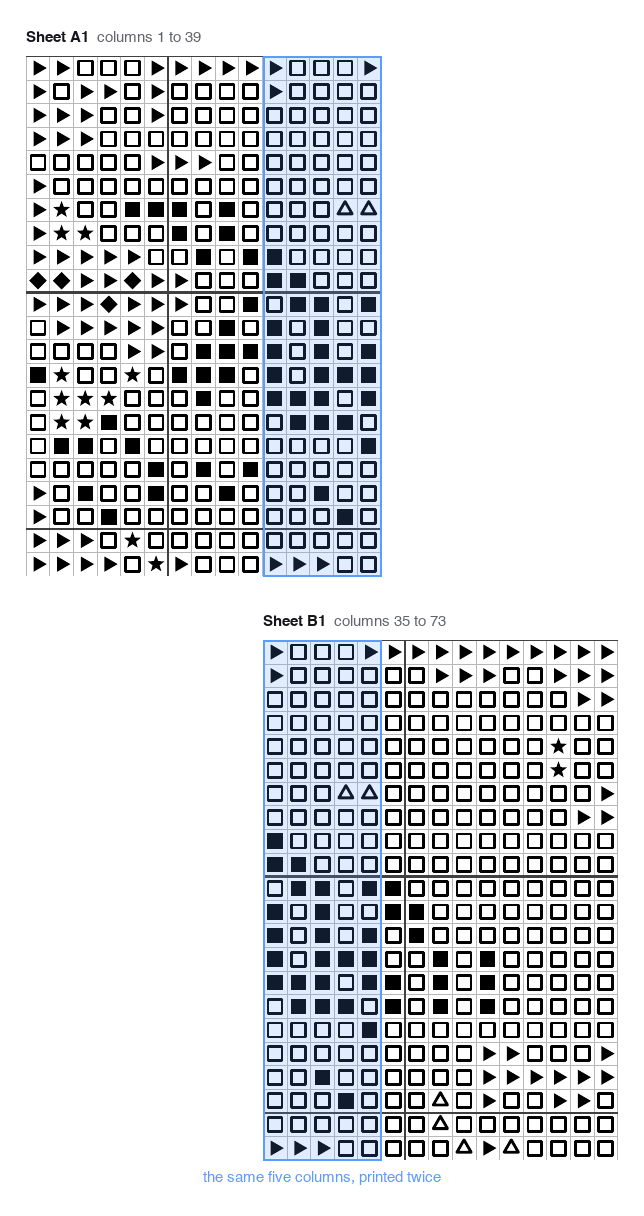
Sheet A1 carries columns 1 to 39. Sheet B1 starts at column 35, not 40. Those five columns are printed twice, on purpose, so you line up the sheets on the stitches themselves and any drift is visible before the tape goes on.
Five squares of overlap on this chart means 2,728 squares get printed a second time, 17 percent more squares than the chart strictly holds. It stays at eight sheets, so the overlap is free in paper. Push it to twenty squares and it stops being free: the layout goes to fifteen sheets.
Zero overlap is available and it is a trap. It saves no paper at all on this chart, only the ink for those 2,728 squares, and it hands you ten butt joints to get exactly right.
The legend goes on its own sheet
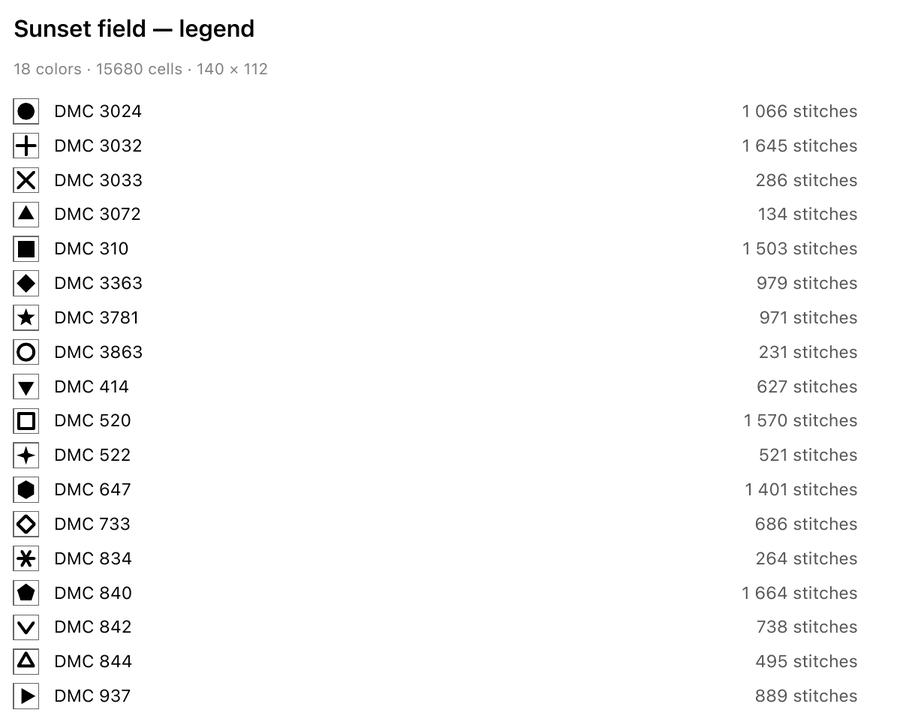
Symbol, DMC number, stitch count, one line each. Thirty lines fit on a page, which covers almost every chart you will make, and it is the single most important sheet in the pile: a chart without its legend is worthless, because nothing else in the world connects a small black triangle to DMC 3363.
The stitch count on each line earns its place: it names the colour to buy two skeins of, and the ones that are nearly nothing.
Practical notes from actually doing this
- Scaling off, 100 percent. Check the first sheet with a ruler: ten squares should be 40 mm.
- Symbols to work from, colour to look at. A colour version of eight sheets is a lot of ink for a thing you will glance at twice.
- Trim two edges, not four. Right and bottom on every sheet, then lay the grid out and tape from the back.
- Number the sheets before you cut. A1, B1, C1, D1 along the top row. Ours are labelled in the footer for this reason.
- Mark the chart in pencil. The sheet you reprint is always the one you had covered in pen.
- Keep the legend separate, not folded inside the chart where it gets taped over.
Reprinting a sheet is the cheap outcome. Getting a seam wrong and finding out forty rows later is the expensive one, and what a miscount costs by the time you notice is worth reading before you tape anything.
The pages above are the real export from Flossgrid, rendered by the app rather than drawn for the article: sheet layout, the 5 square overlap, rulers on every sheet, legend on its own page. Printing and PDF export are free at any chart size. The only thing we charge for is the size of the chart itself.
Questions that come up
Where can I print a cross stitch pattern?
Any home printer will do it, because there is nothing special about the paper: plain white A4 or Letter, black and white, single sided. A print shop is worth the trip only when you want the whole chart on one large sheet, which is the one thing a home printer cannot do. Ask for A1 or A0 at full scale. What you must not do is hand over a PDF and say make it fit, because that is the instruction that produces a chart nobody can count.
How do I print a pattern over multiple pages?
Print at 100 percent, with scaling off, from a PDF that was already laid out in pages. Fit to page is the setting that ruins it: it shrinks each sheet by a few percent, and the seams then refuse to line up because two neighbouring sheets got different treatment. If your file is one huge image rather than a paged PDF, the tiling has to happen before the print dialog, not inside it.
Why can I not just shrink the chart to one page?
Because the squares stop being countable. A 140 by 112 chart on a single Letter sheet needs each square to be 1.3 mm, and 4 mm is the point below which counting a row of twelve stops working. That is not about eyesight so much as about the symbol: at 1.3 mm a triangle and a diamond are the same small dot, and you would be reading the chart with a magnifier for thirty hours.
How do I join the printed pages?
Trim the right hand and bottom margins off every sheet, lay them out on the floor in their grid, and tape the back. Work from the top left and go along rows. If the sheets carry an overlap, the last few columns of one sheet repeat the first few of the next, so you align on the stitches rather than on the paper edge. That is the whole point of the overlap: paper edges are never square, stitches are.
Colour chart or black and white symbols?
Print the symbol version to work from and, if you want it, the colour version once to look at. Symbols photocopy, cost nothing in ink, and stay readable under a lamp, where two similar beiges do not. A colour print of a 140 by 112 chart is 8 sheets of nearly solid ink coverage, and the second time you reprint a page you will have found this out.