Cross Stitch Pet Portrait: Where the Colours Go
A pet portrait is not evenly hard. On one golden retriever chart of 140 by 112 stitches, the head is 56 percent of the squares and uses all twelve threads, the nose is 6 percent and uses eight of them, and the two eyes together are 2 percent and still need seven. The face is where the palette goes.
The dog, and what the whole thing costs
Everything here comes from one photograph: a golden retriever on a porch, head and shoulders filling the frame, shot in late afternoon. It is the same picture used in the general article on turning a photo into a chart, so the numbers on the two pages agree with each other.
At 140 by 112 on 14 count aida the finished piece is 10 by 8 inches. With a twelve colour limit that is 15,584 stitches, 19 skeins and 27.7 hours. What follows is where inside that job the work actually sits, because it is not spread evenly and nobody says so.
The eyes are two percent of the chart and seven of the twelve threads
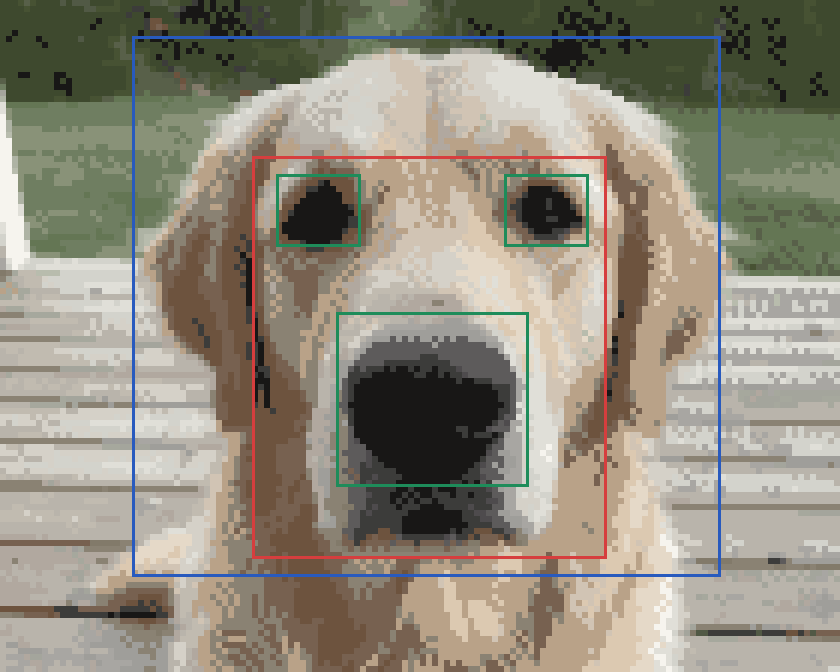
I drew rectangles on the chart and counted which DMC numbers appear inside each one. The rectangles are on the picture, so you can see what was measured rather than take my word for the boundary.
| Region | Squares | Share of chart | Threads used |
|---|---|---|---|
| Head, ears included | 8,820 | 56.2% | 12 of 12 |
| Face, eyes to chin | 3,953 | 25.2% | 10 of 12 |
| Nose | 928 | 5.9% | 8 of 12 |
| Both eyes | 336 | 2.1% | 7 of 12 |
Two things fall out of that table. No thread here exists only for the background: all twelve numbers turn up somewhere on the head, so the grass and the decking are made from threads the dog already needed. I did not expect that.
And the eyes are 336 squares, about a fiftieth of the piece, pulling more than half the palette. If an animal portrait ever looks wrong while the rest of it looks fine, that is why: the squares carrying the likeness are the fewest and the fussiest.
What a bigger palette actually buys
The usual advice is to allow more colours for a portrait. Here is the same photo at five limits, counting how many numbers reach each area.
| Colours allowed | On the head | On the nose | In the eyes |
|---|---|---|---|
| 6 | 6 | 5 | 5 |
| 9 | 9 | 6 | 6 |
| 12 | 12 | 8 | 7 |
| 18 | 18 | 12 | 8 |
| 24 | 24 | 16 | 11 |
Going from twelve to twenty four doubles the shopping list and buys eight extra numbers on a nose the size of a stamp. Whether that is worth it depends on how close people will stand. It also costs in a way the table hides: more numbers means more places where two neighbouring squares disagree, and those isolated single stitches are the ones you will resent. On this photo twelve colours left 25 of them and twenty nine left 124.
Below nine, something else breaks. The eyes drop to five threads and a golden retriever’s brown eye, which is dark ring, iris and a highlight, has to be told in three tones. It reads as a hole.
The count on its own is not the number to watch. Thirty threads on this photo give 66 distinguishable tones once density shading is counted, well short of the 151 that thirty threads could reach, because many of the shades picked are the same thing at arm’s length.
How big before an eye is an eye
A stitch holds nothing smaller than itself, so an eye needs squares to be more than a blob. Here is one eye, on the same crop, at five chart widths.
| Stitches across | Finished size, 14 ct | One eye | Photo pixels per stitch |
|---|---|---|---|
| 60 | 4.3 by 3.4 in | 7 by 6 squares | 17.1 |
| 80 | 5.7 by 4.6 in | 8 by 8 | 12.8 |
| 100 | 7.1 by 5.7 in | 10 by 10 | 10.2 |
| 140 | 10.0 by 8.0 in | 14 by 12 | 7.3 |
| 200 | 14.3 by 11.4 in | 20 by 18 | 5.1 |
The right hand column ends the argument. Going past 140 does not improve the eye on this photo, because the photograph runs out first: at 200 across there are 5.1 pixels behind each square, under the seven you want, and the extra squares average blur. Bigger charts need bigger photographs, not more patience. If you are working from an old picture of an animal that has died, check this before anything else. It is the constraint you cannot fix later.
Taking the picture, if you still can
- Get down to their head height. From standing you get a skull and a snout, and the eyes go small and dark.
- Fill the frame with head and shoulders. Cropping in afterwards throws away the pixels you just measured.
- Daylight, not direct sun. Sun puts a blown white patch on the muzzle that has no thread to match it.
- Never portrait mode. Its synthetic blur is a smooth gradient, and smooth gradients are what produce scattered single stitches.
- Dark animals need light behind them. A black cat lit from the front is a silhouette with no local contrast for the chart to find.
Cutting the background out
The single largest saving in a pet portrait is the thing that is not the pet.
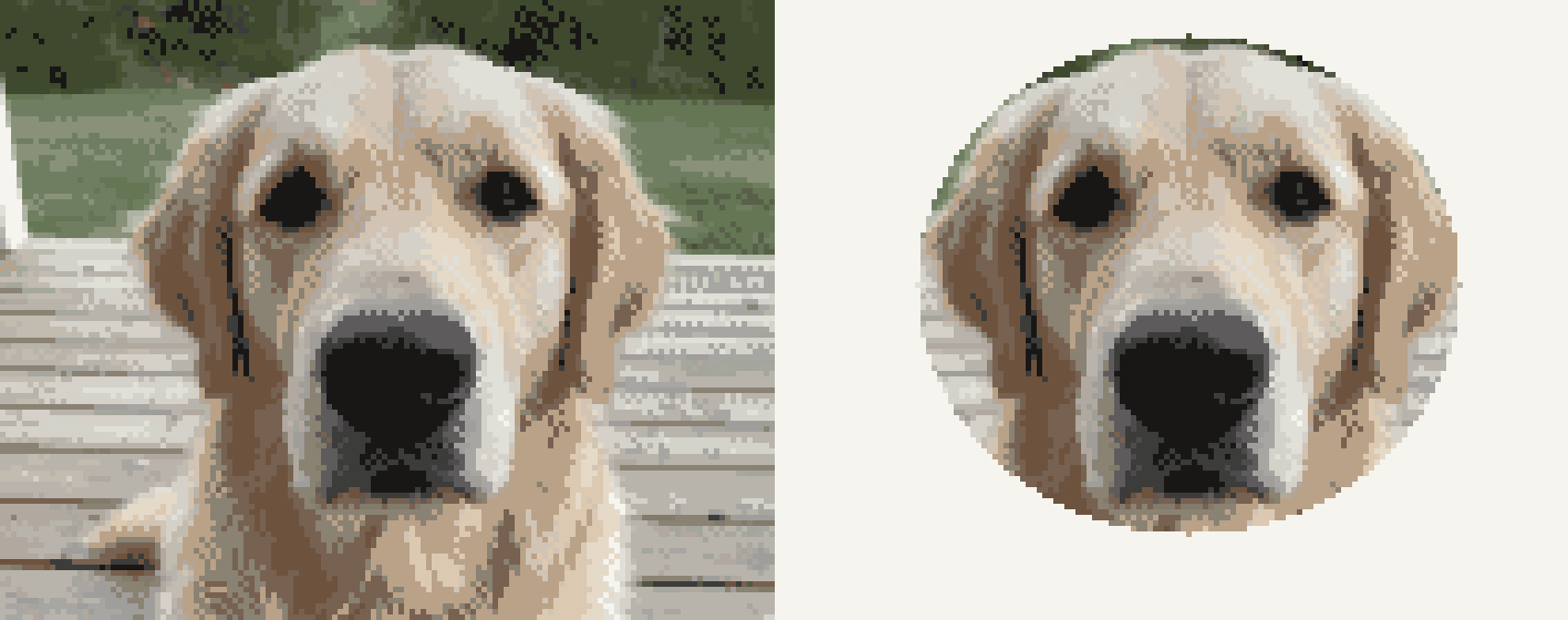
Masking everything outside the head left 6,912 stitches instead of 15,584, 15 skeins instead of 19, and 11.9 hours instead of 27.7. Less than half the work for a piece that says the same thing. The mask is a plain ellipse, cruder than cutting round the ears properly, so a careful cutout would save a little more.
Bare cream aida reads as air rather than as a hole, which is the oldest trick in portrait needlework and costs nothing. What you give up is context.
Fur, whiskers and the parts a grid refuses
Fur works better than people fear, because it has strong local contrast and the chart has something to bite on. Two habits help.
Keep every top diagonal leaning the same way. A portrait is mostly one mid tone in slightly different shades, and if half the crosses lean the other way the surface catches light unevenly and you see it across the room.
Leave the whiskers until the end and put them in as backstitch over the finished crosses. A whisker is thinner than a stitch, so it cannot be a square. The same goes for the fine hairs on an ear edge and the highlight in an eyelid.
Most of the hours in a 15,584 stitch piece are flat and mindless, and most of the difficulty is inside those 336 squares of eye. Do the eyes when you are fresh, and be honest about the total before you cut a 13 by 11 inch piece of aida. Every number here came out of the model Flossgrid runs on, from one photo of one dog.
Questions that come up
How many colours does a pet portrait need?
Twelve is a sensible working number for a head and shoulders, and the reason is where they land rather than how the preview looks. On the chart measured here, twelve threads put eight numbers on the nose and seven in the eyes, which is enough for a wet nose to read as wet. Going to twenty-four adds eight more numbers to the nose and four to the eyes, and almost nothing anywhere else, so you are paying twelve extra skeins for detail inside two small areas. Six is genuinely too few: the eyes drop to five threads and the muzzle flattens.
How do I photograph my dog or cat for a pattern?
Get down to the animal's head height, fill the frame with head and shoulders, and shoot in daylight near a window or outside in shade. Direct sun makes contrast the chart cannot hold, and indoor bulbs put an orange cast on everything, which gets stitched faithfully because the converter matches what is there. Do not use portrait mode. The fake blur it adds is exactly the kind of smooth gradient that turns into scattered single stitches on a grid.
Can you cross stitch a pet that has died?
Yes, and it is one of the commonest reasons people start. The advice has to be different, because you are working from whatever photo exists rather than one you can retake: check the pixels before you commit. A chart 140 stitches across wants about 980 pixels across the crop, so a photo cropped out of a group shot is often the real limit rather than the conversion. If it is short, make the chart smaller instead of accepting a soft one.
Do I need to stitch the background?
No, and leaving it out is the single biggest saving available. Removing the background from the chart measured here left 6,912 stitches instead of 15,584, 15 skeins instead of 19, and 11.9 hours instead of 27.7. The animal still reads, because the eye takes bare cream aida as air. What you lose is the sense of place, which matters for a dog on a beach and not at all for a head against a hedge.
How do you stitch fur so it does not look flat?
Let the chart handle the tone and let the direction handle the fur. Keep every top diagonal leaning the same way, so the light comes off the surface evenly, then add the few long hairs and the whiskers in backstitch at the very end, over the top of the finished crosses. Whiskers are the one part of an animal that a grid cannot do: a whisker is thinner than a stitch, so it has to be a drawn line rather than a filled square.