How Long Does Makeup Last After Opening? A Chart by Product
Most makeup is meant to be used within 6 to 24 months of opening: mascara and liquid liner in 3 to 6 months, liquid foundation and creams in 6 to 12, lipstick and pencils in 12 to 24, powders up to 36. The number is on the pack inside a small open-jar symbol: 12M means twelve months from the day you first opened it.
The chart
Period after opening is set by the manufacturer and printed on the pack as an open-jar symbol. These are the windows you will see most often, and what happens as a product passes them.
| Product | Typical PAO | What goes wrong past it |
|---|---|---|
| Mascara, liquid eyeliner | 3–6 months | Bacteria; dries and clumps |
| Cream eyeshadow, cream blush | 6–12 months | Dries, separates |
| Liquid foundation, tinted moisturiser, BB cream | 6–12 months | Separates, oxidises, changes shade |
| Concealer (liquid) | 6–12 months | Separates, cakes |
| Lip gloss | 6–12 months | Goes sticky, smells waxy |
| Lipstick, lip liner, eye pencil | 12–24 months | Dries, smells of old crayon |
| Powder foundation, blush, bronzer, eyeshadow | 24–36 months | Hard film on the surface, weaker colour |
| Nail polish | 12–24 months | Thickens, separates |
| Moisturiser, serum, cleanser | 6–12 months | Preservatives fade, texture changes |
| Vitamin C serum | 3–6 months once opened | Turns orange-brown as it oxidises |
| Sunscreen | Printed expiry date, usually 2–3 years from manufacture | SPF no longer guaranteed |
The pattern is simple: the more water in the product and the closer it gets to your eye, the shorter the window. Powders and waxes have almost nothing for bacteria to live on; a mascara tube is warm, wet and reopened every morning.
Reading the symbol
The open-jar symbol is required on most cosmetics sold in the EU and used by most brands sold in the US. It shows a number and an M: 6M, 12M, 24M. That is months from the first opening. A product bought two years ago and opened last week still has its full PAO, at least in theory.
Some packs carry a batch code instead or as well — a short string of letters and numbers stamped on the base or the crimp of a tube. That code identifies the manufacturing batch, not the opening date, and it is only useful if you look it up on the brand’s site.
Sunscreen is the exception in both directions. In the US it is regulated as an over-the-counter drug and must carry an expiry date, usually printed on the crimp or the base. Use it after that date and the SPF is simply not guaranteed; the filters degrade, and you will not see or smell the difference.
Why the clock starts at opening
Cosmetics are preserved to survive being opened, touched and left on a shelf, but the preservative system is finite. Each time a jar is opened, air and skin bacteria get in; each time a wand goes back into a tube, it brings something with it. The PAO is the manufacturer’s estimate of how long the preservatives stay ahead of that.
Sealed products are a different case. Unopened, the preservatives face nothing, and most products are fine for two to three years from manufacture. That is why an unopened backup of a favourite is a reasonable thing to keep, and an opened one is not.
What “expired” actually looks like
For most products the risk is disappointment before it is danger:
- Separation. A foundation that needs shaking and still looks streaky.
- Oxidation. Vitamin C turned the colour of weak tea; a foundation gone orange on the skin.
- Smell. Lipstick that smells of crayons, a cream that smells sour or metallic.
- Texture. Mascara that clumps, a gloss gone stringy, a hard film on a pressed powder that no brush gets through.
Any of those means the product is finished, whatever the symbol says. The reverse is also true: a lipstick two years past its PAO that looks, smells and feels the same is very probably fine.
Eye products are where to be strict. Old mascara and liquid liner are the most common cosmetic cause of eye infections, because the tube is reseeded from the lash line every day. Three months is the usual advice; do not push it.
How it looks in Vanity
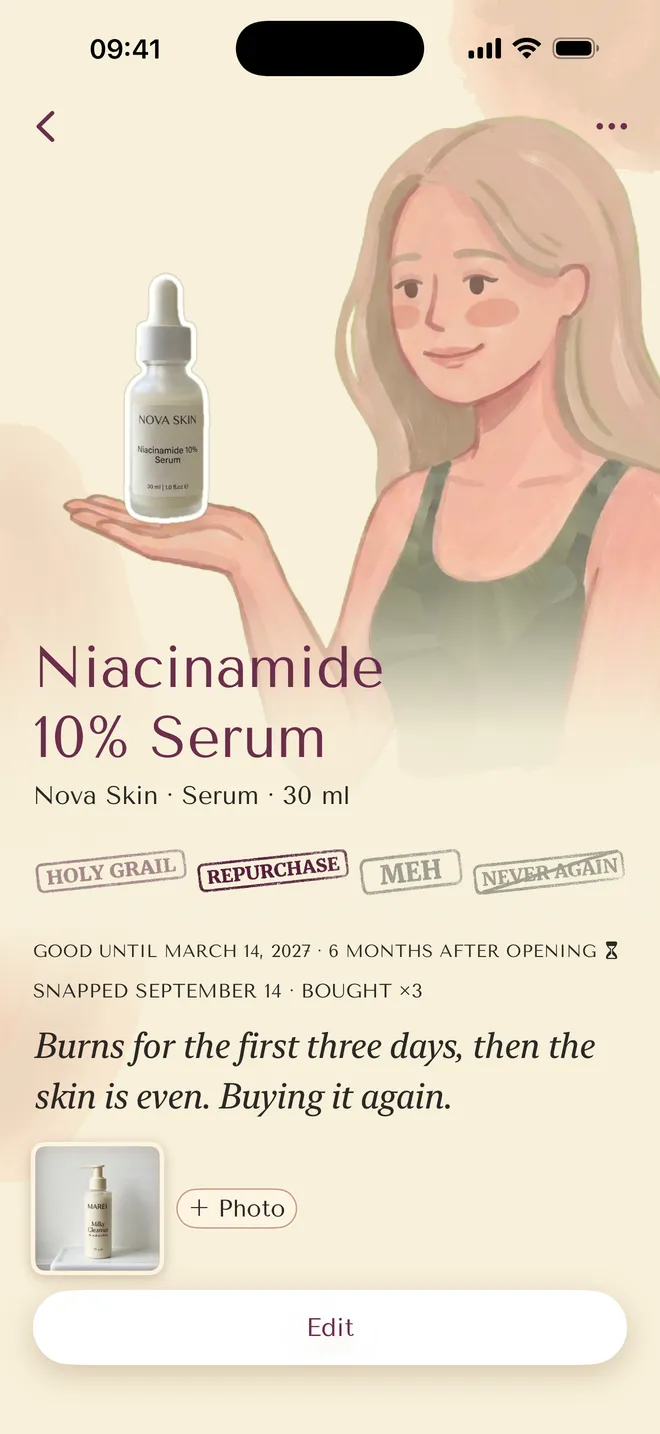
Each product carries the day you opened it, the size read from the label and the period after opening from its lid; the Expiry tab lists everything by what turns first. Open the card and the date is there; when the mascara passes three months, you know before your eye does.
Keeping track without a spreadsheet
The information you need is on the pack; the information you lack is the date you opened it. Nobody remembers. Three methods work:
- A marker dot on the base with the month you opened it. Cheap, and survives the bathroom.
- A note on the phone — one line per product. Works until the list is forty lines long.
- A shelf app that records the date automatically when you add the product and keeps the PAO from the label. Vanity does this from a photo: it reads the label, keeps the 12M it finds there, and dates the product the day it went on your shelf.
Whichever you pick, the payoff is the same: you throw out the mascara at three months instead of finding out the hard way, and you stop discarding a powder that had another year in it. The record of what you finished — and whether it was worth it — is the subject of keeping a skincare diary; using up the half-full drawer before buying more is project pan; and the once-a-year sort that finds the expired things in the first place is in organizing a makeup collection.
Questions that come up
Where is the expiry date on makeup?
Usually there is not one. In the US and the EU most cosmetics carry a period-after-opening symbol instead: a small open jar with a number and an M, such as 6M or 12M. That is the number of months the maker expects the product to be fine after you first open it. Sunscreen and anti-acne products are regulated as drugs in the US and carry a proper expiration date on the pack or the crimp of the tube.
Does unopened makeup expire?
Slowly. Sealed products keep their preservatives intact, so an unopened foundation is generally fine for two to three years from manufacture, and powders longer. The PAO clock starts at opening, but very old unopened stock can still separate or oxidise — an unopened bottle bought from a discount bin five years ago is not a safe bet, whatever the symbol says.
What happens if I use expired mascara?
Mascara is the one product worth being strict about. The wand goes from the tube to the lashes and back, so the tube collects whatever is on the eyelid, and after a few months the preservatives cannot keep up. Old mascara is the most common cosmetic cause of eye infections. Three months is the usual advice, six at the outside, and any change in smell or texture means it is done.
How do I know how long I have had a product?
You do not, unless you wrote it down. Nobody remembers when they opened a foundation. A dot of marker on the base with the month, a note in your phone, or an app that records the day you added the product all work — the method matters less than having one. Vanity records the date a product went on your shelf automatically and keeps the PAO it reads off the label, so the arithmetic is done for you.
Can I make makeup last longer?
A little. Keep it closed, cool and out of the bathroom if the bathroom gets steamy; heat and humidity are what break emulsions and grow bacteria. Do not pump mascara, do not add water to anything, and wash sponges and brushes so you are not seeding the product every time. None of this doubles the window — it stops you shortening it.