Project Pan: How to Finish Your Makeup Without a Spreadsheet
Project pan is a challenge to use up a set number of products before buying new ones, named after the moment the metal pan shows through a pressed powder. You choose 5 to 10 products, use them until they are finished, and record each empty with a verdict. It turns a drawer of half-used things into a short list with an end.
What the challenge is
Project pan started on beauty forums as an answer to a familiar drawer: a dozen half-used products, three new ones on the way, and no idea which of the old ones were any good. The rule is simple — pick a set of products and use them until they are gone before buying replacements. “Pan” is the metal base of a pressed powder; seeing it is the proof.
The reason it works is not thrift, though it is thrifty. It is that finishing a product forces a verdict. You cannot use a moisturiser every day for three months and still have no opinion about it.
Picking the products
A good round has three kinds of item:
- Fast finishers — cleanser, lip balm, a hand cream, a nearly empty serum. These finish in weeks and keep the list moving.
- One long project — a blush, a bronzer or a palette you have hit pan on nowhere. This is the one that takes months.
- One or two doubts — products you keep but never reach for. Using them up produces a verdict either way.
Before anything goes on the list, check its period after opening. A mascara opened a year ago is a throw-out, not a project, and so is anything that has separated or smells wrong. Project pan is for finishing products that are still fine.
How long it takes
| Product, used daily | Time to finish or hit pan |
|---|---|
| Lip balm | 3–6 weeks |
| Cleanser, 150 ml | 6–10 weeks |
| Moisturiser, 50 ml | 2–3 months |
| Serum, 30 ml | 6–10 weeks |
| Liquid foundation, 30 ml | 3–4 months |
| Blush or bronzer | 6–12 months to pan |
| Eyeshadow palette, one shade daily | 9–18 months to pan |
Most rounds run three months. In that time the liquids finish, one powder shows pan, and the list is ready for the next round. If the candidates are still in a drawer you cannot see into, start with the sort in organizing a makeup collection.
Recording the empties
This is the part that turns a challenge into a memory. Each time a product is finished, write down three things:
- What it was — a photo of the pack, or the brand and name.
- When — the month it ran out.
- The verdict — would you buy it again? Four words are enough: holy grail, repurchase, meh, never again.
Do this on paper, in a note, or in an app — the format matters less than the verdict. Vanity keeps a stamp and your note on every product, and a filter by stamp shows your holy grails at a glance, which is the list you want in the shop. A year of stamped products is the only favourites list that was earned rather than guessed — the same record a skincare diary keeps, product by product.
How it looks in Vanity
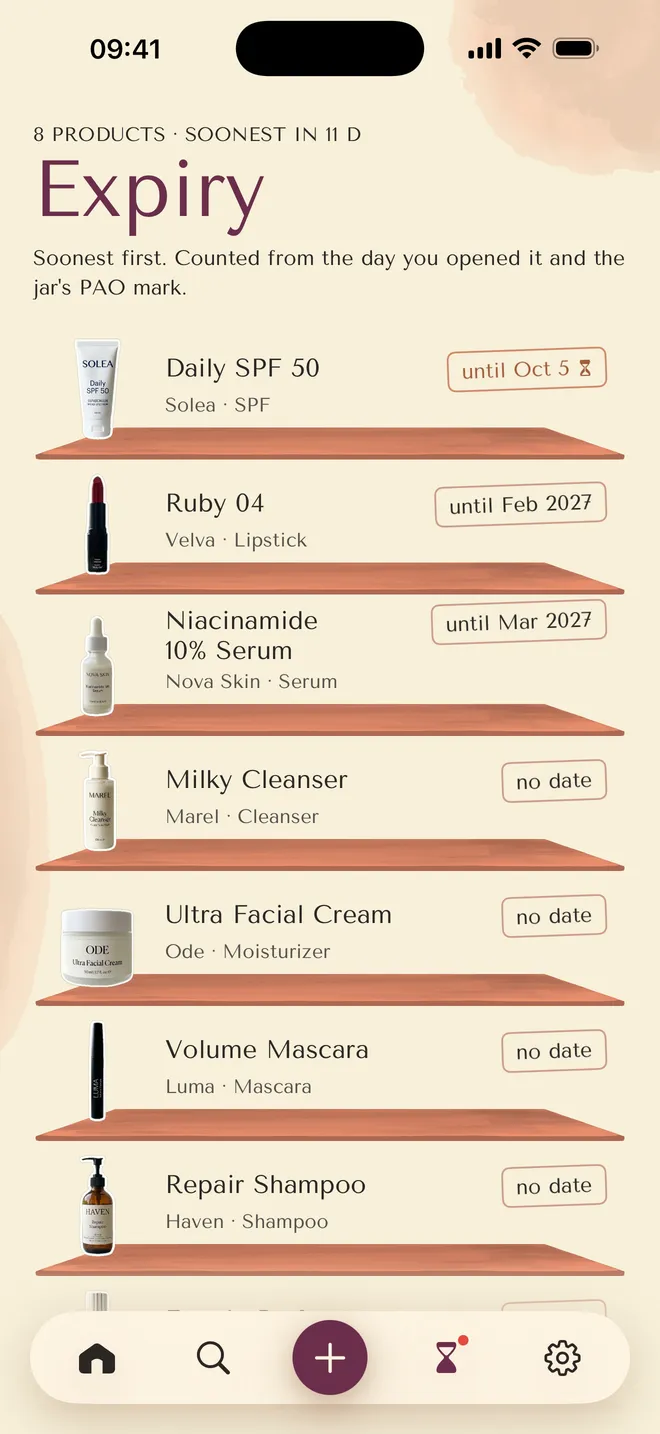
Pick your project pan from the top of the Expiry tab: it lists open products by the date they turn, counted from the day you opened each and the months on its lid. When one is finished, stamp it. At the end of a round, filter Search by holy grail and you have the list of what to rebuy — no spreadsheet in between.
What people get wrong
- Making it a punishment. A round of only disliked products is abandoned by week three. Put things you like on the list.
- Not allowing exceptions. If a product runs out and a replacement is genuinely needed — sunscreen in summer — buy it. The rule is about the drawer, not about going without SPF.
- Counting the panned products as the result. The result is the verdicts. Ten finished products with no notes are ten products you will misremember.
After the round
Look at the empties. The holy grails go on the rebuy list. The never-agains go nowhere near the basket. The mehs are the useful surprise: things you would have rebought out of habit that turned out to be replaceable. Then pick the next five to ten, and start again.
Questions that come up
What does 'hit pan' mean?
It means you have used enough of a pressed powder — blush, bronzer, eyeshadow, powder foundation — to see the metal pan underneath. It is the visible proof that a product is being used, which is why the challenge is named after it. For liquids and creams the equivalent is simply the empty bottle.
How many products should I pan at once?
Five to ten. Fewer and it is not a project; more and it becomes a chore. A common structure is 'pan that palette' — one eyeshadow palette — alongside a few daily items like a cleanser, a moisturiser and a lip product that will finish in a few weeks and keep the list moving.
How long does project pan take?
A daily moisturiser or cleanser finishes in one to three months. A lip balm in a few weeks. A blush or bronzer used daily takes six months to a year to hit pan, and an eyeshadow palette can take a year with regular use. Most people run a project over three months, finish the liquids, hit pan on one or two powders, and start the next round.
Do I need an app for project pan?
You need a list and somewhere to write the verdict; a notebook works. What an app adds is the photo and the search. Vanity lists your open products by what expires first, which is a ready-made pan list, and keeps a stamp on each — holy grail, repurchase, meh, never again — so at the end of a project the holy grails are the list of what to buy again. Thirty-five products are free.
Should I pan products I do not like?
Not if they cause reactions — that is a never-again stamp and the bin, not a project. For products that are merely dull, using them up is fine and satisfying, but do not make a whole project of them or you will resent it and stop. Two or three 'meh' items per round is plenty.