How to Keep a Skincare Diary You Will Read Next Year
A skincare diary earns its keep when it records products, not days: for each one, a photo of the pack, the brand and name, the date you opened it, and a one-word verdict when it runs out. On paper or in an app, daily routine logs are abandoned within weeks and never answer the question you have a year later: what was that serum?
Diaries fail because they log the wrong thing
Most skincare diaries begin as a routine log: morning cleanser, serum, SPF; evening cleanser, retinol, cream; a line about how the skin looks. It is satisfying for a week, tedious by the third, and gone by the second month.
Then, a year later, the question arrives: what was that serum I liked? And the routine log cannot answer it, because it recorded days, not products. The serum is in there as “serum” on forty consecutive evenings.
A diary that lasts records products, once each. It takes a minute when a product arrives and a few seconds when it is finished, and it never asks for anything on an ordinary Tuesday.
What to write down, per product
| Field | Why it earns its place |
|---|---|
| Photo of the pack | You will recognise the bottle long after you have forgotten the name |
| Brand and name | For searching, and for buying the same thing again |
| Type | Serum, SPF, cleanser — so ‘which SPF did I like’ has a short answer |
| Size | Tells you how fast you use things, and which size to rebuy |
| Date opened | The one fact you cannot reconstruct; see how long makeup lasts after opening |
| Verdict, when finished | Holy grail · repurchase · meh · never again |
| A short note | Where you bought it, what it felt like, why you stopped |
Leave out: star ratings (unreadable a year later), ingredient lists (they are on the pack), and daily skin observations (a different document).
The verdict is the whole point
The diary exists so that, standing in a shop, you know whether to buy something again. So the record of each product should end with that decision and nothing vaguer. Four words cover every case:
- Holy grail — you would buy it forever. The list you take to the shop.
- Repurchase — good, buy it again when it runs out.
- Meh — fine, but not again; there are better.
- Never again — it stung, it broke you out, it did nothing.
Write the verdict when the product is finished, not when it is new. First impressions are about texture and packaging; the verdict is about whether the skin was better for it. If you keep the empties — even as a list — the verdicts collect into an honest record of a year. That is the idea behind project pan, too.
Three ways to keep it
Paper. A page per product, or an index card. Pleasant to write, easy to photograph a swatch into, and lost at the first house move or bathroom flood. Searching means flipping.
A notes app. One note per product, or one long note. Works well to about twenty products; after that it is a wall of text, photos are clumsy, and search finds the word “serum” in thirty places.
A shelf app. The advantage is not the app; it is the removal of typing. Vanity reads the brand, name and size from a photo of the label, cuts the product out of the background so the shelf looks like a shelf, and asks for one of the four stamps when you know. Search reaches names, brands, types and notes. Thirty-five products are free, which is roughly one bathroom.
How it looks in Vanity
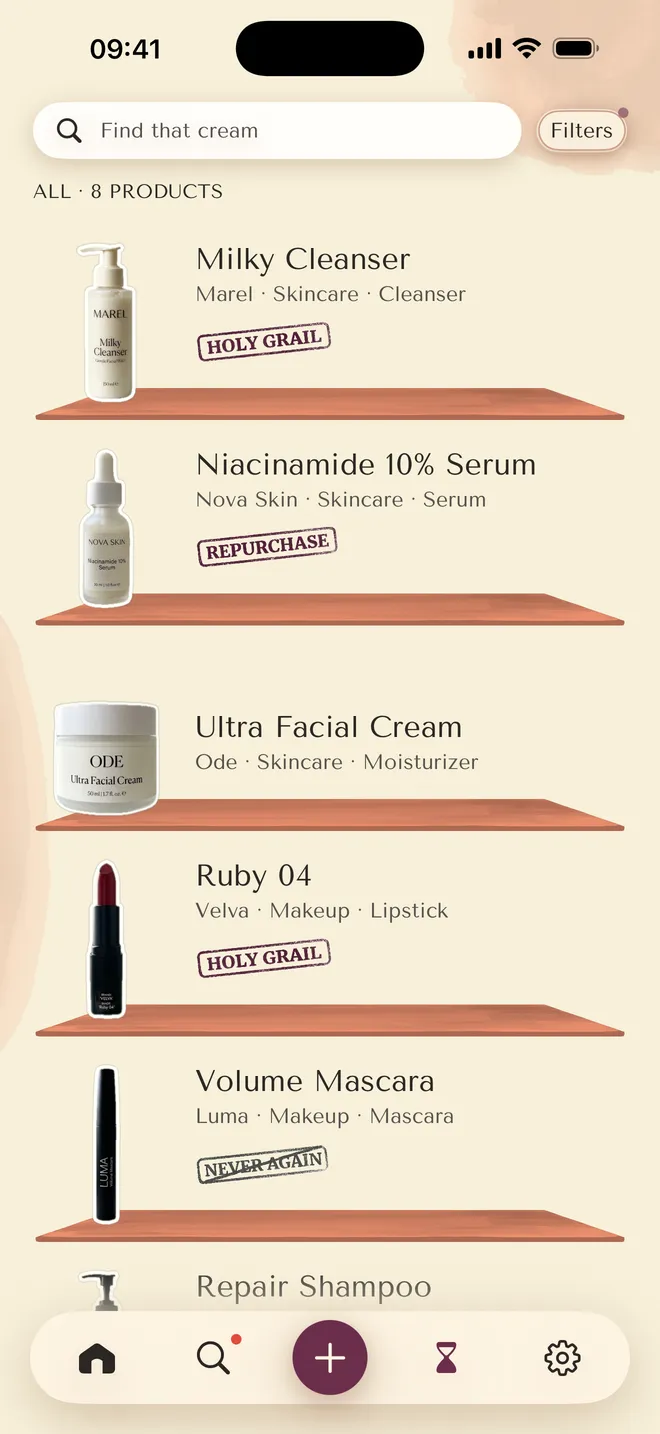
The shelf is the diary: one product per entry, photographed once, with the verdict stamped on the card when you know. Search reaches names, brands, types and notes, so “vitamin C” finds the three you have tried and what you thought of each.
Starting, without cataloguing everything
Do not start with the drawer of things you have not used in a year. Start with what is on the counter — the ten products you used this week. Photograph them, fix a name or two, and stop. Add the next one when you buy it, and stamp the first one when it runs out.
Six months later the diary will have thirty entries, a dozen verdicts, and the answer to the question you have not asked yet.
Questions that come up
What should a skincare diary include?
For each product: a photo of the pack, the brand and product name, the type (serum, SPF, cleanser), the size, the date you started it, and — when it is finished — a verdict on whether you would buy it again. Optionally a short note: where you bought it, what it felt like, why you stopped. That is enough to answer every question you will ask it later. Anything more is a chore that shortens the diary's life.
Should I log my routine every day?
Only if you are testing something specific for a few weeks — a new active, a suspected reaction — and then stop. A daily routine log is the format most people start with and abandon within a month, because it asks for effort every day and pays back almost never. The product log asks for a minute per product and pays back for years.
Paper, notes app or a dedicated app?
Paper is pleasant and dies on the first move house. A notes app works for twenty products and becomes a wall of text at sixty, and a photo per product is awkward in it. A dedicated app is worth it when it removes the typing: Vanity reads the brand and name from a photo of the label, cuts the product out so the shelf is recognisable at a glance, and asks for one stamp when the product is finished. The point of any of them is the same — search 'vitamin C' and see the three you have tried, with verdicts.
How do I rate products so the rating still means something later?
Do not use stars. A three-star rating from 2024 tells you nothing today. Use a decision instead: would you buy it again? Vanity uses four stamps for exactly this — holy grail, repurchase, meh, never again — because each one is an answer to the question you will actually have in the shop. Even on paper, write one of those four words and nothing else.
Should I track my skin as well?
Not in the same place. Breakouts, redness and reactions are worth noting if you are working something out with a dermatologist, but that is a health record with a different audience and different privacy needs. Keep the product diary about products. If a product caused a reaction, that goes in its note — 'stung, stopped after three days' — which is a fact about the product, and the reason for the never-again stamp.