Cross Stitch Birth Sampler, Planned Before the Birth
A birth sampler is a sampler whose text is the birth record: name, date, time, weight, length. The one charted here is 99 by 63 squares, 1,173 stitches and about 1.9 hours in total, and the figures that cannot exist until the day account for 474 of those stitches, about 46 minutes. Everything else can be stitched while you wait.
The problem with a birth sampler
Almost everything on it is text, and you do not have the text yet.
The name is often decided late and sometimes changed. The date, the time, the weight and the length do not exist until the day. So the usual advice, start early, runs straight into the usual reality, which is that people put the whole thing off until after the birth and then have a newborn and no evenings.
The way out is arithmetic. Here is the piece I charted, and then how little of it is actually waiting on anybody.
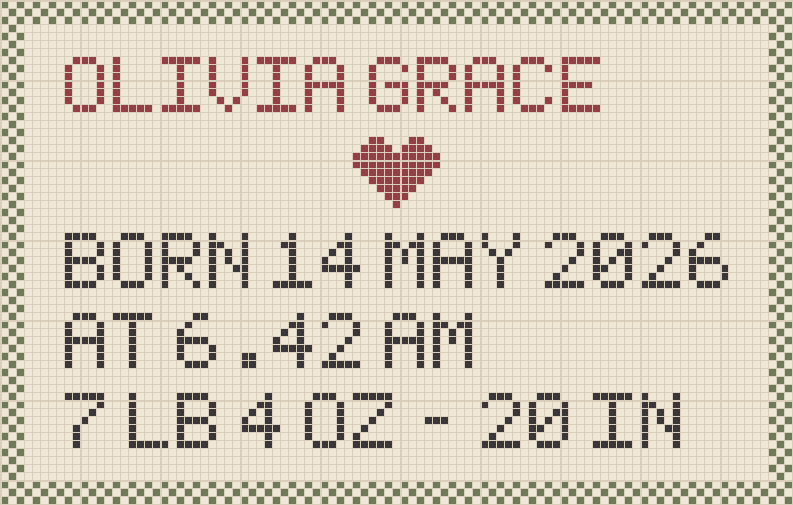
Ninety nine squares by sixty three. On 14 count aida that finishes at 7.1 by 4.5 inches; on 18 count, 5.5 by 3.5. It comes to 1,173 stitches, three DMC numbers, three skeins and about 1.9 hours, which is roughly $2.48 of materials at US shop prices.
What you are actually waiting for
| Part | Squares wide | Stitches | Time | Known in advance? |
|---|---|---|---|---|
| Border, all four sides | 99 | 468 | 45 min | yes |
| Heart motif | 13 | 59 | 6 min | yes |
| OLIVIA GRACE | 67 | 172 | 17 min | usually |
| BORN 14 MAY 2026 | 83 | 206 | 20 min | no |
| AT 6.42 AM | 51 | 112 | 11 min | no |
| 7 LB 4 OZ, 20 IN | 77 | 156 | 16 min | no |
Split three ways: the border and the motif are 527 stitches and 51 minutes and are certain from the start. The name is another 172 stitches, 17 minutes, and is usually settled before the birth. The figures that genuinely cannot exist until the day, the date, the time, the weight and the length, come to 474 stitches and about 46 minutes.
So the last evening is under an hour of work. Everything before it can be done while you wait, which is the opposite of how these are usually made.
Leaving the right gap
The trap in stitching text last is the gap. Every capital in this alphabet is five squares wide, so it is the number of letters that moves, and it moves a long way. AMY is 17 squares. ALEXANDER is 53. OLIVIA GRACE is 67. THEODORE JAMES is 79.
Two habits fix it.
Centre everything, and mark the centre column with a tacking stitch in sewing thread before you start. Then a name that came out four letters longer than you planned grows evenly into both margins instead of shunting the whole block sideways.
Chart the longest plausible line, not the likely one, and set the border width from that. If the border is sized to a short name and the long one turns up, the piece is wrong in a way that cannot be repaired. Working out the width in squares takes a minute and saves the entire border.
Size it to a frame you can buy
This is the part people get wrong and it is the expensive mistake.
A standard 8 by 10 inch frame is 112 by 140 squares on 14 count aida. A 5 by 7 frame is 70 by 98. Pick the frame first, convert it to squares, and design inside that number. The chart above at 99 by 63 drops into an 8 by 10 with a mat around it and no custom work.
Cut the cloth three inches bigger than the design in each direction, so 10 by 7.5 inches here. That margin is not generosity, it is what the mounting board needs to hold on to when the piece is laced over it and framed.
Going to 18 count shrinks the same chart to 5.5 by 3.5 inches, which fits a 5 by 7 frame and makes a much smaller, denser object. Nothing about the chart changes, only the cloth.
Threads, and why three is enough
Three DMC numbers carried the whole piece: a dark one for the body text, a colour for the name, a second colour for the border. That is not a limitation, it is what makes a text piece read. Every colour you add is another thing competing with the words.
It is also almost free. Three skeins is about $1.65 of floss, and a skein at two strands is roughly 24 usable metres, which means one skein of the dark thread would carry the text on about a dozen of these. If you are making one for each grandchild, you have already bought the thread.
Practical notes nobody mentions
- Do not stitch a due date. People do, and then the baby is nine days late.
- Ounces and pounds, or grams, but decide on the chart. 7 LB 4 OZ is 17 characters with the spacing; 3.29 KG is 7. The layout is not the same.
- Wash it before framing even though it looks clean. Hand oils yellow years later, behind glass, where you cannot get at them.
- Stitch it on cream, not white. Bare cloth is most of the surface on any lettered piece, so the cloth colour is doing more work than the threads.
- Write the year in full. A sampler that says 26 will confuse somebody.
A birth sampler is the smallest serious project in this craft: two evenings, three skeins, and a frame you already own. The band structure it borrows is what makes it that easy, and the reason the tradition survives is that it works. Put your frame size into Flossgrid and it will tell you how many squares you have to play with before you chart a single letter.
Questions that come up
What goes on a birth sampler?
The name, the date of birth, and usually the weight and the length. Time of birth is common, place is less so. Beyond that it is a sampler like any other: a border, a motif or two, and space arranged around a block of text. What distinguishes it is that almost all of it is lettering, so the alphabet you pick and the width of the longest line decide the whole layout before you have chosen a single colour.
Can I start it before the baby is born?
Yes, and you should, because the part you cannot stitch is a single evening. On the chart here the date line is 206 stitches, the time 112 and the weight and length 156, which is 474 stitches and about 46 minutes altogether. The border and the motif are 527 stitches on their own and depend on nothing. Leave gaps of the right width, stitch everything else, and finish once the numbers exist.
How big should a birth sampler be?
Work backwards from the frame, because framing an odd size is what turns a finished piece into a piece in a drawer. A standard 8 by 10 inch frame is 112 by 140 squares on 14 count aida, and the design here at 99 by 63 sits comfortably inside it with a mat. Decide the frame, convert to squares, then design to fit. Doing it the other way round means a custom frame, which costs more than the whole sampler.
How long does a birth sampler take?
About two hours of stitching for the piece on this page, spread over a couple of evenings. That is a very small project by cross stitch standards, and the reason is that lettering on bare cloth covers hardly any of the surface. If you want it to feel like a proper gift, spend the extra effort on a wider border and a bigger motif rather than on more text, because text is what makes a layout go wrong.
What if the name or the date changes?
Then you unpick a line, which is the argument for stitching the text last and keeping it in one colour. A name line of twelve characters is 172 stitches, so removing it and doing it again is an evening at worst. What cannot be repaired is a border sized to a short name when a long one arrives, because the border is 468 stitches and it defines the edges of the piece. That is what the placeholder gap is protecting.