What Is a Cross Stitch Sampler, and How to Make One
A sampler is a piece built from bands rather than from a picture: an alphabet, numbers, a border, some small motifs, and a line naming who made it and when. The one charted here is 91 by 70 squares, 1,666 stitches, three DMC numbers and about 2.7 hours, because only 26 percent of its squares are stitched at all.
What a sampler actually is
A sampler is a piece of counted work built in horizontal bands rather than composed as a single picture. The bands are conventional: a border round the edge, one or two alphabets, a row of numerals, a strip of small repeated motifs, and a line of text naming the maker and the year.
That structure is the whole idea. Nothing on a sampler is trying to be a photograph of anything, which is why samplers look the way they do and why they behave so differently under the needle.
Here is one I charted to have real numbers to talk about.
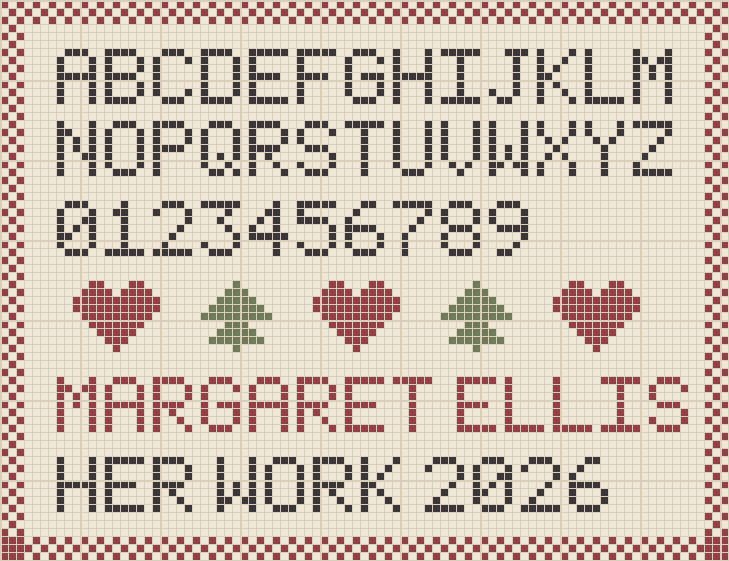
Ninety one squares by seventy, which on 14 count aida finishes at 6.5 by 5 inches. Three DMC numbers. 1,666 stitches, about 2.7 hours, three skeins, and roughly $2.49 of materials at US shop prices.
Why the alphabet is on there
The usual account is that samplers started as reference sheets. Before printed charts were easy to come by, a needleworker kept a strip of linen with stitches and motifs recorded on it, to copy from later. By the seventeenth century the form had hardened into schoolwork, and generations of girls stitched an alphabet and a set of numerals as an exercise.
The reason it was an alphabet rather than anything else is dull and practical: household linen was marked with initials so it could be told apart, and marking linen means knowing letters by heart. The skill outlived the laundry.
I would treat any more specific history you read with mild suspicion, including mine. What is not in doubt is the shape of the surviving pieces, and the shape is bands.
What each band costs
Splitting the sampler above into its parts gives an unusually clear picture of where the evening goes.
| Band | Stitches | Floss | Time |
|---|---|---|---|
| Alphabet, both rows | 398 | 7.7 m | 39 min |
| Numerals 0 to 9 | 148 | 2.8 m | 14 min |
| Name line | 206 | 3.9 m | 20 min |
| Motto line | 181 | 3.6 m | 18 min |
The rest is the border and the motif band. A whole alphabet, the thing that looks like the big job, is under forty minutes. This is the useful property of band work: every piece of it is a finishable unit, so the work always ends at a natural place rather than in the middle of a shaded cheek.
Against a photograph, measured
Put the sampler next to the converted photograph used elsewhere on this site, a golden retriever at 140 by 112 with a twelve colour palette, and the difference is not what people assume.
| Sampler | Photo portrait | |
|---|---|---|
| Squares carrying a stitch | 26% | 99% |
| Stitches on one thread before a colour change | 10.3 | 3.2 |
| Isolated single stitches | 0 | 25 |
| Needles for the whole piece | 56 | 528 |
| Needles per 1,000 stitches | 33.6 | 33.9 |
The last row is the honest one. Rethreading per stitch is identical, because rethreading follows the length of thread you use, not the number of colour changes. The sampler is not more efficient. It is simply smaller, because most of its area is bare cloth, and bare cloth is free.
The row above it is where the difference in feel comes from, and it is worth saying how it is counted: empty squares are skipped, because bare cloth does not make you rethread. On a photo chart, where 99 percent of squares are stitched, that is the same number as the plain run length quoted elsewhere on this site. On a sampler it is not, and ten stitches in a run against three is the difference between working and fiddling. And the stray single stitches that a converted photograph produces cannot happen here at all, because every square was placed by hand and nobody places a stray one.
Building your own
- Chart the widest band first. Almost always the alphabet. Its width plus margins plus the border gives you the outside size, and everything else has to live inside that.
- Three empty rows between bands. Two looks crowded, four looks like a gap.
- Two accent colours, no more. In the chart above the border and the hearts share one, the trees have another, and everything else is one dark thread. Restraint is what stops a sampler looking like a scrapbook.
- Put the motif band in the middle. It breaks the run of text and gives the eye somewhere to rest.
- Leave the name line until last. Not for ceremony: it is the band most likely to change while you are working, because you will change your mind about the year, the wording or the spelling of somebody’s surname.
The lettering is the part that stops people, and it is the easy part. A capital in a 5 by 7 alphabet is about fifteen stitches, and a whole name is a quarter of an hour.
Cloth and framing
Cut 9.5 by 8 inches for the sampler above, which is three inches more than the design in each direction. Samplers are usually worked on cream or unbleached cloth rather than white, partly because it is traditional and partly because bare cloth is 74 percent of the surface here, so the fabric colour is doing more of the work than any of the threads.
Linen is the traditional choice and it is worked over two threads, so 28 count linen gives the same 14 stitches to the inch and the same finished size as the aida used for the numbers above. Nothing in the chart changes; only the cloth does.
At 6,370 squares the whole thing sits inside the free limit in Flossgrid, which is worth knowing before you assume a piece this size is a big project. It is two evenings and three skeins.
Questions that come up
Why do cross stitch samplers have alphabets on them?
Because the alphabet was the useful part. The usual account is that samplers began as working reference sheets, a place to record stitches and motifs before printed patterns were widely available, and that they became schoolwork for girls in the seventeenth and eighteenth centuries. The practical skill being taught was marking household linen with initials so it could be told apart at the laundry, which meant knowing an alphabet by heart. The alphabet survived on the cloth long after the reason for it did.
What goes on a sampler?
A border round the outside, one or two alphabets, a row of numbers, a band of small repeated motifs, and a line saying who stitched it and when. That last line is the part people leave off and later wish they had not. Beyond that the form is open: modern samplers carry house names, wedding dates, a list of children, a joke. What makes it a sampler is that it is built in horizontal bands rather than composed as one picture.
Is a sampler good for a beginner?
It is the best big piece for a beginner, and the numbers say why rather than the tradition. It is made of blocks of one colour, so you get about ten stitches on a thread between changes instead of three, there are no isolated single stitches to chase, and each band finishes on its own so the work always looks done rather than half done. It is also cheap: three skeins covers the one charted here.
How long does a cross stitch sampler take?
The one on this page is about 2.7 hours of stitching for a finished 6.5 by 5 inches, which is a couple of evenings. That is far quicker than a photo portrait of the same finished size, and the reason is not skill or stitch type: only 26 percent of the sampler's squares carry a stitch at all, against 99 percent of a converted photograph. Bare cloth is most of a sampler and it costs nothing to work.
How do I design my own sampler?
Start with the widest line, usually the alphabet, because it sets the width of everything else. Chart that row, add the side margins and the border, and you have the outside dimensions before you have decided anything else. Then stack the remaining bands down the middle with three empty rows between them, and keep the motif band and the border in the same two accent colours so the piece reads as one thing rather than a scrapbook.