How to Cross Stitch Letters, Counted by the Square
Letters are charted, not drawn: each one is a small block of squares, and you count them like any other part of a pattern. In the 5 by 7 alphabet charted here a capital averages 15 stitches. The name OLIVER is 35 squares wide, 91 stitches, about 1.8 metres of floss and roughly ten minutes.
The alphabet I am counting
Numbers about letters mean nothing without the alphabet they came from, so here is mine. Two of them: a 5 by 7 block capital, which is the shape most free alphabets settle on, and a 3 by 5 miniature for when a line has to fit somewhere it does not want to go.
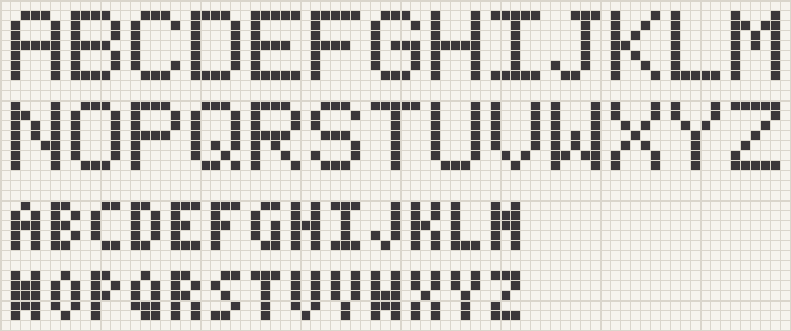
Every figure below comes off these two. Your alphabet will differ, sometimes by a lot, and that is the first useful thing to know: a letter has no fixed cost.
What a letter costs
In the 5 by 7 alphabet a capital averages 15.3 stitches and fills 44 percent of its box. The range is wider than you would guess: B is 20 stitches and Y is 10, so a name of six B’s is twice the work of a name of six Y’s.
| Letter | Stitches | Letter | Stitches |
|---|---|---|---|
| B | 20 | O | 16 |
| A, D, E, M, N, R, W | 18 | P, S, U | 15 |
| G, H, Q | 17 | K, F | 14 |
| I, Z | 15 | C, V, X | 13 |
| J, L, T | 11 | Y | 10 |
The miniature alphabet averages 9.1 stitches, but fills 61 percent of its box, which is the whole problem with small letters. There is nowhere for the shape to go. A 5 by 7 A has an empty row inside the counter; a 3 by 5 A does not.
Whole names
Spacing is one empty column between letters and three between words. Widths and times below are for 14 count aida, two strands, one colour.
| Name | Alphabet | Squares | Stitches | Width, 14 ct | Floss | Time |
|---|---|---|---|---|---|---|
| EMMA | 5 by 7 | 23 by 7 | 72 | 1.6 in | 1.4 m | 7 min |
| EMMA | 3 by 5 | 15 by 5 | 44 | 1.1 in | 0.9 m | 5 min |
| OLIVER | 5 by 7 | 35 by 7 | 91 | 2.5 in | 1.8 m | 10 min |
| BRUNO | 5 by 7 | 29 by 7 | 87 | 2.1 in | 1.7 m | 9 min |
| MARGARET | 5 by 7 | 47 by 7 | 136 | 3.4 in | 2.6 m | 14 min |
| THE JOHNSONS | 5 by 7 | 67 by 7 | 172 | 4.8 in | 3.3 m | 17 min |
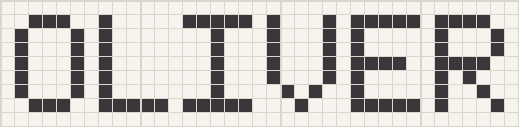
A name is a small thing. That is the point of the table: adding a name to a piece you were making anyway costs about a quarter of an hour, and people put it off for weeks because it feels like a whole new problem.
The thread figures surprise people the other way. One skein at two strands is about 24 usable metres, so a single skein of DMC 310 carries roughly thirteen names the length of OLIVER, plus the tails. Nobody needs to buy thread for lettering.
How tall, in millimetres
The most common thing people search for is a letter height, and the arithmetic is one division: squares divided by fabric count is inches.
| Letter height | 11 ct | 14 ct | 16 ct | 18 ct | 22 ct |
|---|---|---|---|---|---|
| 3 squares | 6.9 mm | 5.4 | 4.8 | 4.2 | 3.5 |
| 4 | 9.2 | 7.3 | 6.3 | 5.6 | 4.6 |
| 5 | 11.5 | 9.1 | 7.9 | 7.1 | 5.8 |
| 7 | 16.2 | 12.7 | 11.1 | 9.9 | 8.1 |
| 10 | 23.1 | 18.1 | 15.9 | 14.1 | 11.5 |
| 12 | 27.7 | 21.8 | 19.0 | 16.9 | 13.9 |
The same alphabet is a different size on every cloth, which is why “5 high” means nothing on its own and the fabric count is the number that settles it. Seven squares on 18 count is under 10 mm, which is small print.
Where small letters go wrong, measured
Everyone says do not go below five squares. Here is the reason, as a number.
Take every pair of capitals in an alphabet and count how many squares differ between them. In the 5 by 7 block, the closest pairs are D and O at two squares apart, and M and N also at two. In the 3 by 5 miniature, five pairs differ by exactly one square: H and K, H and M, H and W, K and X, M and N.
One square is one miscount. On a five square alphabet, a slip turns an H into a K and you do not notice until the word is finished, which is the same failure as any other counting error except that it is in the middle of somebody’s name.
Backstitch instead
Filled letters are not the only option, and for a long line they are often the wrong one. Take the line THE JOHNSONS 2026, 93 squares wide, 6.6 inches on 14 count:
- as filled crosses: 234 stitches, 4.5 m of floss, about 23 minutes
- as backstitch along the same shapes: about 1.9 m, about 11 minutes
Backstitch runs at roughly half the cost because a line stitch is about half the work of a cross. It also looks completely different: thin, drawn, closer to handwriting. And it is the only way to get a curve, because backstitch runs along the grid lines rather than filling squares, so it can go diagonally across a corner where a cross stitch cannot.
The compromise most samplers use is both: the name in filled capitals, the date and the small print in backstitch.
Practical order of work
- Decide the alphabet before the layout. Two alphabets of the same height can differ by 30 percent in width, and the layout depends on the width.
- Chart the whole line, count the squares, then centre it. Fold the cloth twice to find the middle and count out half the width.
- Stitch the middle letter first, not the first letter. If anything is out, the error splits between both ends instead of pushing one end off the cloth.
- Leave the backstitch until last, over the top of finished crosses.
- One thread does the whole line. At about 1.5 cm of floss per cross, a name is two or three needles, which is why lettering feels so fast compared with an area of shaded colour.
Lettering is where charting your own work is easiest to start, because nothing is accidental: you place every square yourself, so there are no stray single stitches to clean up and no palette to argue with. Put a line of text into Flossgrid and it gives back the squares, the inches on your cloth and the thread, before you have cut anything.
Questions that come up
How do you cross stitch letters?
Exactly as you stitch anything else. An alphabet chart gives each capital as a small block of filled and empty squares, usually five wide by seven tall, and you count those squares onto the fabric like any other motif. There is no special stitch and no special technique. The only new decisions are which alphabet to use, how much space to leave between letters, and where the whole word sits, and all three are settled before the needle goes in.
How tall should cross stitch letters be?
Seven squares for a capital is the usual working size and it is what most free alphabets give you. On 14 count that is 12.7 mm, on 18 count 9.9 mm, on 11 count 16.2 mm. Five squares still reads and is what people reach for when a line has to fit. Three squares is where letters start being guessed rather than read: in the tiny alphabet charted here, H and K, H and M, H and W, K and X, and M and N each differ by a single square.
How much space goes between letters?
One empty column between letters and three between words is the default, and it is the spacing every number on this page was measured with. Some letter pairs look tight at one column, usually anything next to an L or a T where the shape leaves a gap of its own, and the fix is to add a column for that pair rather than to widen everything. Do the spacing on the chart, not on the fabric, because a name that grew by two squares halfway along has to come out.
Should letters be cross stitch or backstitch?
Cross stitch for anything you want to read from across a room, backstitch for anything small or fine. The same seventeen character line charted here is 234 crosses, 4.5 m of floss and about 23 minutes as filled squares, and roughly 1.9 m and 11 minutes as backstitch along the same outline. Backstitch is faster and thinner. It also lets you write a script or a curve, which a filled grid cannot do at all.
How do you centre a name on the fabric?
Work out the width in squares first, halve it, and count out from the centre crease of the cloth. The name OLIVER in this alphabet is 35 squares, so it starts 17 or 18 squares left of centre. Do not start at the left end and hope. A name is the one thing on a piece where being two squares off centre is visible to everybody, because the eye measures the margins against each other.