Cross Stitch Bookmark and Other Small Gifts
The bookmark charted here is 30 by 104 squares, 651 stitches and about 63 minutes of stitching on 14 count. That is one evening, four DMC numbers and roughly $2.79 of materials, and it prints on two sheets of paper. Small gifts are the only projects most people actually finish.
An evening, counted
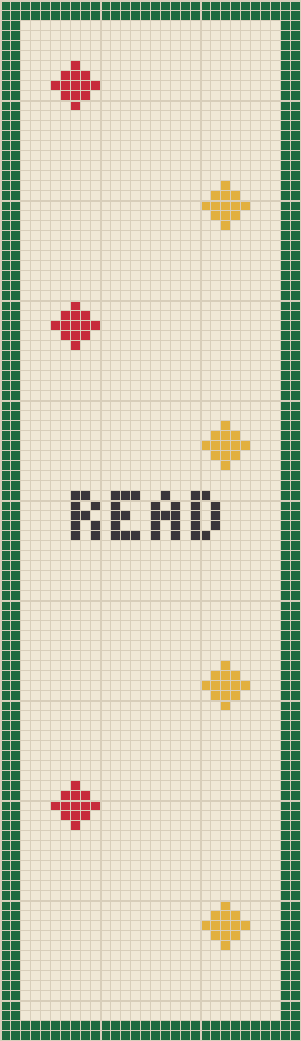
Thirty squares by one hundred and four. On 14 count aida that finishes at 2.1 by 7.4 inches, which is a normal bookmark that sits in a paperback without sticking out at both ends.
- 651 stitches, 21 percent of the squares in the strip. Most of it is bare cloth, which is what makes it fast.
- 4 DMC numbers: a green border, a red motif, a gold motif, a dark for the word.
- 4 skeins, about $2.79 of floss and cloth.
- About 63 minutes of stitching, 22 needlefuls.
An hour. That number is the entire argument for making one. Most cross stitch projects have a gap of weeks or months between the enthusiasm that starts them and the evening they get finished, and the gap is where projects die. A bookmark does not have a gap.
What one skein really covers
The four skeins are not used evenly, and the arithmetic is more lopsided than people expect:
| Colour | Thread used | Bookmarks from one skein |
|---|---|---|
| DMC 699, the border | 10.0 m | 2 |
| DMC 725, the gold motifs | 1.0 m | 24 |
| DMC 321, the red motifs | 0.8 m | 30 |
| DMC 310, the word | 0.8 m | 30 |
A skein divided into two strands gives about 24 usable metres. The border eats ten of them on its own, because a border is a long thin thing that goes all the way round, and the motifs eat almost nothing.
So a set of four skeins makes two bookmarks, and then you buy one more skein of green. It is worth knowing before you plan a set of six for Christmas: the green is the shopping list, everything else you already have. That lopsidedness is the same reason skeins get counted per colour rather than by total length, and the same reason a colour used for thirty stitches still costs a whole skein.
The rest of the small gift shelf
Same idea, different shapes. These are worked at the same 21 percent coverage as the bookmark above, which is what a bordered design with scattered motifs comes out at.
| Object | Squares | Finished on 14 ct | Stitches | Time | Sheets to print |
|---|---|---|---|---|---|
| Keyring | 24 by 24 | 1.7 by 1.7 in | 121 | 12 min | 1 |
| Ornament | 40 by 40 | 2.9 by 2.9 in | 336 | 33 min | 1 |
| Card insert | 56 by 40 | 4.0 by 2.9 in | 470 | 46 min | 2 |
| Coaster | 50 by 50 | 3.6 by 3.6 in | 525 | 51 min | 2 |
| Bookmark | 30 by 104 | 2.1 by 7.4 in | 651 | 63 min | 2 |
| Pincushion | 60 by 60 | 4.3 by 4.3 in | 756 | 74 min | 2 |
Two things stand out. The whole shelf is under 80 minutes. And a chart stops fitting on one sheet of paper at 45 squares across, which is why the coaster and the card need two sheets while the ornament needs one: the paper is cut by squares, not by inches.
Every one of these is far inside the 10,000 stitch free limit, so nothing on this page needs the paid tier. The only thing we charge for is chart size, and none of these are big.
Finishing, which is most of the questions
Nobody asks how to stitch a bookmark. They ask how to finish one, and there are three answers.
Fringed. Trim to about six squares past the border on the short ends, then pull the horizontal threads out one at a time until you have a fringe. Fastest, prettiest, and it keeps unravelling for the rest of its life unless you run a line of machine stitching or a row of backstitch across the base of the fringe first. Do that line before you pull anything.
Backed with felt. Trim to four squares, fold the margin behind and press, cut felt to the finished size, and either blanket stitch round the edge through both layers or glue with a thin even coat. This is the version that survives a handbag. It also hides the back of your stitching, which matters more here than anywhere else because the back rubs against paper.
Aida band. Sold as a narrow strip with a finished woven edge on both long sides, often with a decorative border already in it. Two of your four edges are solved before you start, and it is the reason bookmarks are the one project where a specialist fabric is genuinely worth buying.
Whichever you choose, wash and press before you cut anything. Hand oils yellow years later and a bookmark gets handled more than any other piece you will make.
Making a set without losing interest
The trap with small gifts is deciding to make eight of them.
Six identical bookmarks is six hours, which sounds fine and is not, because the fourth one is boring in a way the first one is not. What works better is one chart with a variable middle: the same border, the same motifs, a different name or word on each. The border is muscle memory by the third one, and the part that changes is the part that keeps you interested.
That also matches the shopping list. The border colour is what you buy more of; the accent colours you already have from the first one.
If this is your first project rather than your ninth gift, a bookmark is a better start than a kit, and the first hour of cross stitch covers what happens in it. If you are still assembling the basics, the short list of what to buy is genuinely short.
Put a bookmark sized design into Flossgrid and it comes back with the stitches, the skeins per colour and the minutes before you cut the aida. Everything at this size is free.
Questions that come up
How long does a cross stitch bookmark take?
About an hour for the one on this page, which is 651 stitches at a fair pace plus the time lost rethreading. That is genuinely one evening, and it is the reason bookmarks are the standard first finished object: the gap between starting and holding a finished thing is short enough that nothing intervenes. A denser design of the same size, with the background filled in, would be nearer three hours.
How do I finish a cross stitch bookmark?
Press it face down on a towel, trim the aida to about four squares outside the border, then either fringe the short ends by pulling threads out, or fold the margin behind and back the whole thing with felt. Felt is the sturdier answer and it is what stops the back of the stitching from catching on pages. Blanket stitch round the edge through both layers, or glue it with a thin even layer and press it under a book overnight.
Are cross stitch bookmarks too thick?
Fourteen count aida with a felt backing is about as thick as a business card, which a paperback tolerates and a thin novel does not love. If you want a slim one, work on 18 count or on 28 count evenweave over two threads: same chart, smaller finished size, and much less bulk in the cloth. The other half of the answer is the back of your stitching. Long loose carries across the back are what make a bookmark lumpy, not the fabric.
What else is worth making at this size?
A keyring at 24 by 24 squares is 12 minutes. A hanging ornament at 40 by 40 is about half an hour. A coaster at 50 by 50 is 51 minutes, and a card insert at 56 by 40 is 46. Those are all real projects with a recipient, and any of them is finishable in an evening, which is a thing that stops being true above about a thousand stitches.
What fabric for a bookmark?
Aida band is the neat answer: it comes in narrow widths with a woven decorative edge, so two of your four edges are finished before you start. Otherwise plain 14 count aida works and you deal with the edges yourself. Avoid anything with a loose weave that frays when handled, because a bookmark lives in a bag and gets pulled about, unlike a framed piece that never moves again.