Cross Stitch Christmas Stocking, Finished in Time
The stocking charted here is 98 by 182 squares, 9,888 stitches, and about 15.9 hours of stitching on 14 count. Starting on 1 November that is 18 minutes a day to Christmas Eve. Starting on 10 December it is 68 minutes a day, every day, and that is the version people abandon.
What a stocking actually costs
Most advice about Christmas stockings is about which pattern to pick. The thing that decides whether it gets hung is the calendar, and nobody puts a number on that, so here is one.
This is the stocking I charted to have something real to count.
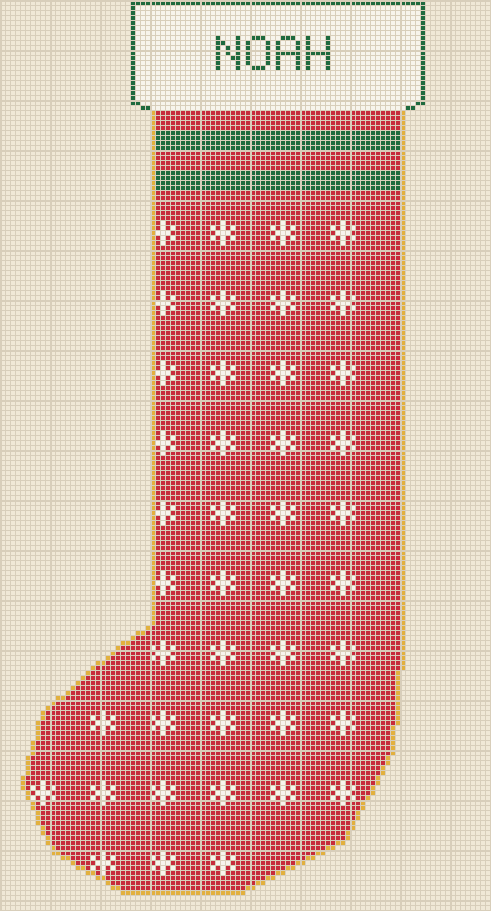
Ninety eight squares by one hundred and eighty two. On 14 count aida that finishes at 7 by 13 inches, which is a normal stocking you can hang off a mantelpiece without it looking like a sock or a sack.
- 9,888 stitches, which is 55 percent of the 17,836 squares in the rectangle. The rest is bare cloth outside the boot.
- 4 DMC numbers: a red, a green, a winter white, a gold for the edge.
- 10 skeins, about $7.26 of floss and aida at US shop prices.
- About 15.9 hours of stitching, and 330 needlefuls of thread.
Four colours and 16 hours is the shape of the thing. A stocking is not a difficult piece, it is a big flat area of one colour with a name on it, and the difficulty is entirely that it is due on a specific evening.
The date you have to start
Take Christmas Eve as the deadline, because that is the night it has to be on the mantelpiece.
| You start | Days left | Stitching a day | Being honest |
|---|---|---|---|
| 1 November | 53 | 18 min | 27 min |
| 15 November | 39 | 25 min | 37 min |
| 1 December | 23 | 42 min | 62 min |
| 10 December | 14 | 68 min | 102 min |
The middle column is pure arithmetic: 15.9 hours divided by the days. The right hand column multiplies it by 1.5, which is the correction for the gap between hours sat with a piece and hours actually stitched. That factor comes from the working estimate of how long cross stitch takes, and it is the honest column.
Eighteen minutes a day in November is nothing. An hour and three quarters a day in the middle of December, in the same fortnight as everything else that happens in December, is a fantasy. This is the entire content of the advice “start early”, except now it has a number attached.
If you would rather think in evenings than in days:
| Evening length | Evenings needed |
|---|---|
| 30 min | 32 |
| 45 min | 22 |
| 1 hour | 16 |
| 1.5 hours | 11 |
| 2 hours | 8 |
Twenty two evenings at 45 minutes is a comfortable November. Nobody gets 22 consecutive evenings in December.
Working faster, and the limit of that
Pace changes the answer less than you would hope. The same 9,888 stitches:
- at 8 a minute, an unhurried evening pace: 24.7 hours
- at 14 a minute, a fair working pace: 15.9 hours
- at 20 a minute, going properly: 12.4 hours
Doubling your speed does not halve the total, because about a fifth of it is threading needles rather than making stitches, and a needle takes 45 seconds to cut, separate, thread and anchor whatever pace you stitch at. Three hundred and thirty needlefuls is four hours of the sixteen, and you cannot go faster at it.
What does help is the shape of the work. A stocking is huge blocks of one colour, so the thread runs long and the colour changes are rare. That is the opposite of a photo portrait, where the needle changes constantly, and it is why 16 hours of stocking feels much shorter than 16 hours of a face.
Cloth, count and the cuff
Cut the aida three inches larger than the design in each direction, so 10 by 16 inches for this one. The making up takes that margin: seam allowance, the hem at the top, and the bit the hanging loop is sewn into. Cutting to the finished size is the mistake you make once.
On 11 count the same chart finishes at 8.9 by 16.5 inches, which is a big generous stocking and noticeably faster to work because the squares are larger. On 18 count it is 5.4 by 10.1, which is a small elegant one. The chart does not change at all. Only the cloth does.
The cuff carries the name, and the name is the reason the whole object exists. Four letters in a block alphabet is 23 squares wide, seven tall; a longer name runs wider fast, and a cuff sized for NOAH will not hold ISABELLA. Chart the longest name in the family first and size the cuff from that, because the width of a name in squares is a thing you can work out in a minute and cannot fix afterwards.
Printing it
At 98 squares across the chart runs to 12 sheets of Letter paper plus a legend page, which surprises people. It is a tall chart, so it goes three sheets across and four down, and the number of sheets follows the squares, not the fabric count. Print the symbol version, tape it up on the wall, and cross rows off as you go.
At 17,836 squares this chart is past our free limit of 10,000, so it is one of the sizes the paid tier exists for. The printing itself is free at any size.
What the hours do not include
Two things, and both are real.
Making it up. The stitched panel is not a stocking. It has to be washed, pressed face down, backed, sewn, clipped at the curves, turned, hemmed and given a loop. That is an evening with a machine, or two by hand, and it is the same washing and pressing routine as framing right up to the point where the needle goes in.
The second stocking. Nobody makes one. You make one, somebody in the family notices, and next year there are two. Which is an argument for keeping the chart and the DMC numbers somewhere you will find them in eleven months, and for buying the red by the skein rather than by the exact metre.
Put the chart into Flossgrid and it gives you the hours and the shopping list in October, which is the month in which knowing it is useful.
Questions that come up
How long does a cross stitch Christmas stocking take?
About 16 hours of stitching for the one on this page, which is 9,888 stitches at a working pace of 14 a minute plus the time lost rethreading. A slower evening pace of 8 a minute makes it nearly 25 hours. Neither figure includes making the panel up into a stocking, and neither includes the evenings you sit with it and do forty stitches while watching something.
When should I start a Christmas stocking?
The first week of November, if you want it to be pleasant. That is 53 days to Christmas Eve and 18 minutes a day of stitching, which is a cup of tea. Leave it to 1 December and the same piece needs 42 minutes every single day. Leave it to 10 December and it is 68 minutes a day with no days off, which is how a stocking becomes a January project with a name half stitched on the cuff.
What size should a cross stitch stocking be?
The one charted here is 98 by 182 squares, which is 7 by 13 inches on 14 count aida and a normal, hangable size. Going to 11 count makes the same chart 8.9 by 16.5 inches, which is a large stocking and 60 percent more cloth. Cut the fabric three inches bigger than the design in each direction, so 10 by 16 inches here, because the making up eats the margin.
How do I finish a cross stitch stocking?
Wash and press the panel first, face down on a towel. Then cut a back from the same fabric or from a plain cotton, right sides together, sew round the stocking shape leaving the top open, clip the curves at the heel and toe, turn it out, and hem the top with a hanging loop in the seam. A lining is optional and makes it much sturdier. It is an evening with a sewing machine, and it is not counted in the stitching hours above.
Counted or stamped for a stocking?
Counted, if you want the name to be right. Stamped kits print the design on the cloth, which sounds easier, but the name is the whole point of a personalised stocking and a stamped kit has decided the letters for you. Counted work lets you chart the name at the width it actually needs, and the cuff is the one part of the piece nobody else can supply.